


Blurb combines book-making tools with printing, making it a useful starting point for creators turning photographs or manuscripts into books. That starting point becomes less relevant when your main decision is how to produce and distribute a finished title. The best Blurb alternative in 2026 is Dazzle Printing if you need a custom print run of at least 25 copies; Lulu if you need print-on-demand publishing.
- For Blurb alternatives in 2026, choose Dazzle Printing for custom book printing in runs of at least 25 copies.
- Lulu suits print-on-demand publishing when you do not want to organize a bulk print run.
- Blurb remains a practical choice when its book-making tools already support your project.
- Compare binding, proof approval, and distribution before choosing a book printer.
Why this matters
Choosing a book printer and choosing a publishing platform are different decisions. A printer produces copies you can distribute yourself; a publishing platform can also provide tools for creating, publishing, or selling a title.
Start with what happens after printing. If you need books for a workshop, copies for an event, or a recurring magazine shipment, compare production requirements first. If you want readers to order individual books without your managing a batch, compare print-on-demand workflows instead.
For your 2026 project, the right alternative is the one that matches that next step—not the one with the longest feature list. Keep your manuscript, artwork, and audience fixed while you compare providers, so you are judging the service rather than redesigning the project around it.
Blurb alternatives at a glance
| Provider | Best for | Standout feature | How it differs from Blurb | Main trade-off |
|---|---|---|---|---|
| Blurb | Creators who want book-making tools alongside printing | BookWright book-design software | Baseline: combines book creation with print production | Its design tools are less relevant if your files are already finished |
| Dazzle Printing | Custom multipage print runs of at least 25 copies | Perfect bound, saddle stitch, wire-o, and plastic coil binding | Centers the decision on a custom printing order | Not a fit when you need fewer than 25 copies |
| Lulu | Authors choosing print-on-demand publishing | On-demand book production and publishing services | Offers a publishing-led alternative to Blurb's book-making workflow | You still need to prepare suitable files and review the printed result |
The table separates production from publishing. It does not establish a universal winner: a finished training workbook and a photography book still in layout need different kinds of help.
Before requesting estimates, write down your finished page count, binding preference, quantity, and required arrival date. Use the same specifications for every provider. Otherwise, differences in the books themselves can look like differences between printers.
1. Dazzle Printing: best for custom multipage print runs
Dazzle Printing is the best Blurb alternative for custom book printing when you need at least 25 copies and plan to handle distribution yourself. Its services include books, magazines, catalogs, workbooks, comics, and other multipage publications. You can choose among perfect bound, saddle stitch, wire-o, and plastic coil binding.
That makes this a production-focused choice. Instead of starting with a book-design application, start with how readers will use the finished publication: reading a novel, consulting a manual, completing exercises, or browsing a catalog.
Where this option shines
- Defined batch quantities: The minimum order is 25 copies, giving you a clear starting point for an event, class, or publication run.
- Binding choices: Four binding types let you compare a conventional book format with options suited to reference and working documents.
- Multipage project focus: Books, workbooks, magazines, and manuals fit the service's stated scope.
- A clear production milestone: Orders ship in 4 to 6 days after proof approval. Plan delivery time separately.
Where this option falls short
- It is not suitable for fewer than 25 copies. If you only need a personal copy or occasional individual orders, use a different production model.
- Saddle stitch has an 80-page maximum. A longer publication needs a different binding choice.
- The shipping schedule starts after proof approval. An unfinished manuscript or delayed approval does not belong inside that production window.
Head-to-head with Blurb
| Dimension | This custom-printing option | Blurb |
|---|---|---|
| Starting point | A defined multipage printing order | A book-making and printing workflow |
| Useful project types | Manuals, workbooks, magazines, books, and catalogs | Photo books, trade books, and other book projects |
| Binding decision | Perfect bound, saddle stitch, wire-o, or plastic coil | Check the binding choices for the specific book format |
| Creation workflow | Prepare your publication for a print order | BookWright provides a book-design route |
Best for: Businesses, creators, trainers, and publishers ordering a batch of multipage publications.
Verdict: Buy when your quantity meets the minimum and the binding suits the way readers will use the book.
Choose the binding before finishing the layout
Binding is not just a finishing detail. It affects the space you need near the inside edge and how comfortably readers can use the publication. Make this choice before you finalize text boxes, illustrations, and page-spanning artwork.
| Binding | Practical starting point | Layout consideration |
|---|---|---|
| Perfect bound | Novels, paperback books, and publications with a glued spine | Keep important content clear of the inside edge |
| Saddle stitch | Shorter booklets and magazines | Confirm the page count fits the 80-page maximum |
| Wire-o | Workbooks, reference documents, and planners | Leave room for the punched binding edge |
| Plastic coil | Manuals, workbooks, and frequently handled documents | Keep text and artwork clear of the punched edge |
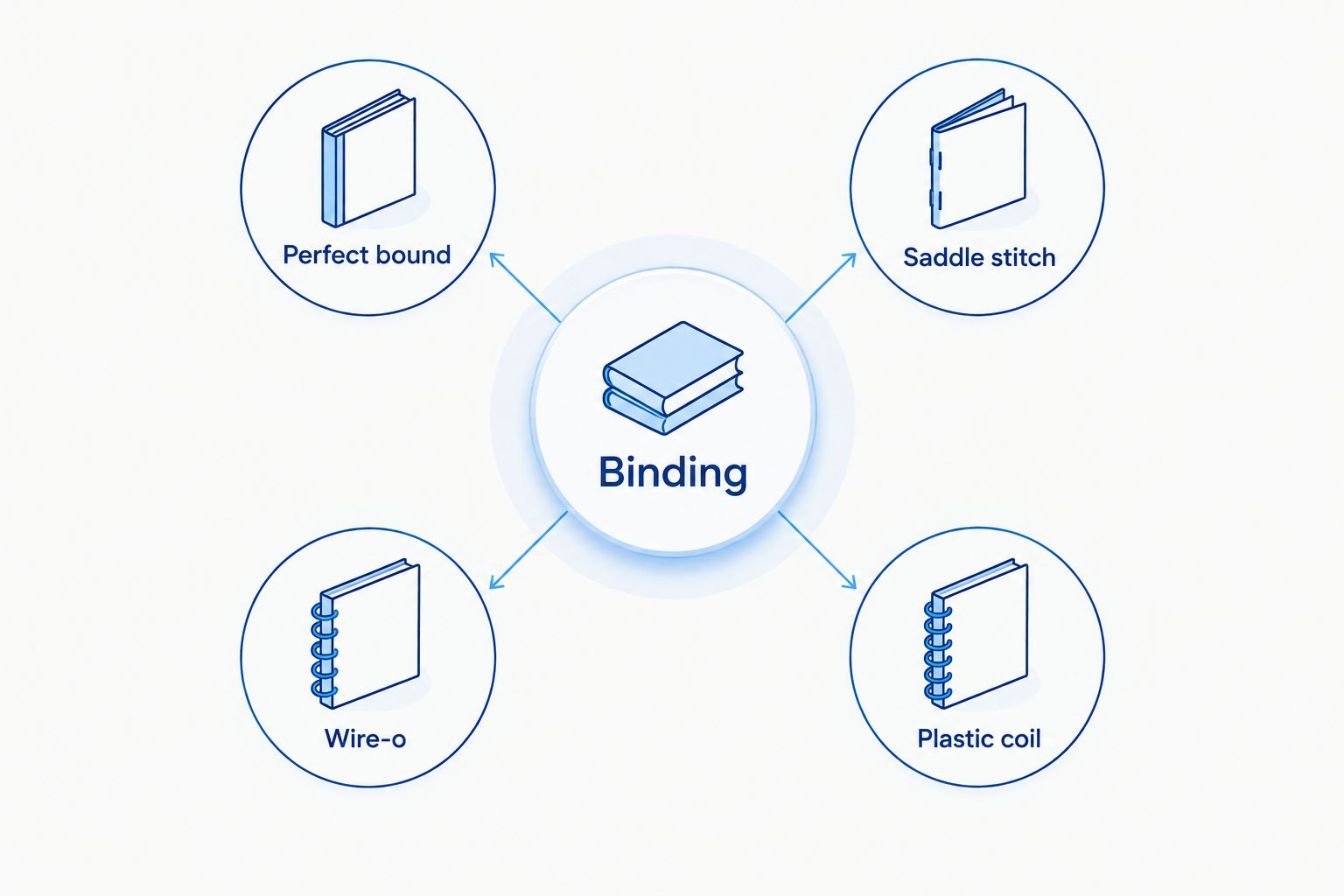
For a 2026 training workbook, begin with the writing and reference experience rather than the cover alone. For a novel, begin with comfortable reading and the relationship between the text and spine. Neither decision requires changing the content; both deserve attention before you approve the final files.
Do not assume that switching printers means your existing layout is ready unchanged. Check the selected printer's file requirements against the exact format you are ordering, then inspect the proof for content near the binding edge.
2. Lulu: best for print-on-demand publishing
Lulu is a Blurb alternative for authors who want a print-on-demand publishing route rather than organizing a batch for their own distribution. Its publishing services make it a relevant comparison when your question is how readers will obtain a book, not simply who will print your next shipment.
Compare the workflow around the book as carefully as the book itself. Decide whether you want copies delivered to you or a publishing arrangement that supports reader orders.
Where Lulu shines
- Print-on-demand production: It suits a publishing plan built around individual orders rather than a stock of books you distribute yourself.
- Publishing orientation: You can evaluate book production alongside the services involved in bringing a title to readers.
- An alternative workflow: It gives authors another publishing route to compare with Blurb's book-making approach.
Where Lulu falls short
- Print-on-demand does not replace file preparation. You remain responsible for the content, layout, and suitability of the files you submit.
- It does not remove proof review. Check the printed result before treating the title as ready for readers.
- A publishing workflow is not automatically the right workflow for an event batch. If you need copies delivered together, compare that order separately.
Head-to-head with Blurb
| Dimension | Lulu | Blurb |
|---|---|---|
| Main comparison | Print-on-demand publishing workflow | Book creation and printing workflow |
| Design consideration | Confirm your chosen file-preparation route | BookWright is an available design route |
| Decision to resolve | How readers will order the title | How you will create and produce the book |
Best for: Authors comparing print-on-demand publishing services for a finished title.
Verdict: Buy if reader-by-reader ordering is central to your publishing plan and the selected format meets your requirements.
Why people switch from Blurb
There is no need to assume a problem with Blurb to justify choosing another provider. A change in the project can be enough. Use these specific decision points to determine whether an alternative fits your next publication.
Your project needs a working-document binding
A workbook or reference manual has a different job from a book made mainly for continuous reading. If readers need to write, consult instructions, or turn pages repeatedly during a task, put binding near the top of your comparison.
Do not treat that as a claim that one provider is better at every book. It means the physical use of this publication should determine which formats you investigate.
You need a planned batch
An event, course, church directory, or recurring publication can require copies delivered together. In that situation, compare the quantity, proof process, binding, and shipping schedule for the complete order.
A minimum of 25 copies is a useful dividing line for this comparison. Below it, the custom-printing recommendation here does not fit; at or above it, you can evaluate that option against your actual production needs.
Your files are already finished
If your publication is fully designed, book-making software carries less weight in the decision. Focus instead on whether the printer can produce the intended format from suitable files.
Keep a copy of your editable source files as well as the print-ready version. That makes corrections easier if the proof exposes a margin, image, or pagination problem.
You want a different distribution model
Receiving a batch and sending individual orders to readers are different responsibilities. Choose which responsibility you want before comparing providers.
For a 2026 release, map the path from approved file to reader. Include who receives the books, who handles distribution, and when the books must arrive. That short exercise prevents a publishing-service comparison from answering a printing-order question.
When staying with Blurb is the right call
Stay with Blurb when its book-making tools suit your project and the printed format meets your requirements. A familiar workflow has practical value, especially when your layout is already built around it.
Blurb's BookWright software is a concrete reason to keep it on your shortlist if you want a guided book-design route. Switching providers solely to collect more options does not improve the manuscript, photographs, or reading experience.
For an existing title, inspect a current copy and identify what actually needs to change. If the answer is nothing beyond a routine reorder, compare the effort of moving files with the benefit you expect. Keep the provider when the current result meets the brief.
FAQ
What’s the best Blurb alternative in 2026?
Dazzle Printing is the best fit here for custom multipage print runs of at least 25 copies; Lulu is the alternative to compare for print-on-demand publishing. Choose according to quantity, binding, and how readers will receive the books.
Is Lulu better than Blurb for my book?
Lulu is the more relevant option to investigate when your priority is a print-on-demand publishing workflow. Blurb remains a practical choice when its book-making tools and printed formats already meet your needs.
Can I order fewer than 25 copies from the recommended custom printer?
No. The minimum custom print quantity is 25 copies, so a smaller requirement needs a different printing option.
What binding should I choose for a workbook?
Compare wire-o and plastic coil first when readers need to write in or repeatedly consult the workbook. Check the binding-edge margins before finishing the layout.
What’s the maximum page count for saddle stitch?
The saddle stitch maximum for the custom-printing service recommended here is 80 pages. Choose another binding if your publication exceeds that limit.
Does shipping in 4 to 6 days mean the books arrive then?
No. The stated schedule is shipping in 4 to 6 days after proof approval, not arrival within that period. Allow separately for file corrections, approval, and delivery.
One last thing
Before placing a full order, make a simple paper mock-up and use it the way your reader will. Turn pages while following instructions, hold it open while writing, or check where a photograph meets the inside edge.
That exercise is not a substitute for a printer's proof. It answers a different question: whether the format serves the content. Choose the physical reading experience first, then choose the provider that can produce it.
Related guides


