


Choose Dazzle Printing if you need a custom multipage print run starting at 25 copies with a choice of four binding types; choose Printing Center USA if it already holds your approved project specifications and keeping a repeat order consistent is your priority. This 2026 comparison separates a new-project decision from a repeat-order decision so you can choose on the requirements that matter.
- Dazzle Printing vs Printing Center USA: choose by print quantity, binding, proof approval, and repeat-order requirements.
- Dazzle Printing suits multipage printing projects starting at 25 copies, with four binding types.
- Printing Center USA is the conditional choice for an established repeat order with approved specifications.
- Compare matching written specifications before choosing a printer; production time is not delivery time.
Why this matters
A book, workbook, or magazine is not just a file sent to a press. Binding changes how readers use it, page count limits your options, and proof approval affects your schedule. Choosing the printer before settling those details puts the decision in the wrong order.
For a new project, Dazzle Printing offers a stated starting point: a 25-copy minimum, four binding types, and shipping in 4 to 6 days after proof approval. For an established project, your previous approved copy is an equally important starting point. Use both kinds of evidence in your 2026 decision.
At a glance
The repeat-order recommendations below apply when you already have a satisfactory Printing Center USA job to match. They are not claims that one printer automatically produces better work.
| Dimension | Dazzle Printing | Printing Center USA |
|---|---|---|
| Best for | New multipage projects matching the stated production options | Repeat projects with an approved result you want to preserve |
| Minimum quantity | 25 copies | Confirm the minimum for your selected specifications |
| Binding choice | Perfect bound, saddle stitch, wire-o, plastic coil | Confirm the required binding on the current quote |
| Scheduling | Ships in 4 to 6 days after proof approval | Use the current order's written production and shipping schedule |
| Repeat-order continuity | Establish a new approved reference when switching | Conditional winner when the previous approved job meets your needs |
| File preparation | Follow the requirements for the selected binding and size | Conditional winner when your existing files remain accepted unchanged |
| Pricing model | Quote the complete job against your specifications | Quote the same complete job against identical specifications |
| Standout feature | Four binding types for different reading and writing uses | An existing approved order, when you have one |
A 25-copy minimum gives a small new project a clear starting point
Best for: creators, course organizers, and publishers planning a defined batch. A stated minimum lets you decide whether a printer fits your project before spending time on detailed file preparation. Here, that starting quantity is 25 copies.
Count the copies you actually need for the intended audience. A workshop workbook, a poetry collection, and a church directory have different distribution plans, even when their initial quantities match. Order planning starts with recipients, not with a larger quantity chosen just to make a quote look attractive.
The limitation matters too: a project below the stated minimum does not fit this ordering requirement. Do not choose a 25-copy run if you only want an individual keepsake and have no use for the remaining copies.
For Printing Center USA, confirm the minimum on the exact configuration you are considering. A minimum is an eligibility requirement, not proof that one printer is better at every quantity.
Four binding types make reader use the first decision
Best for: buyers choosing between a reading book and a working document. The four stated choices are perfect bound, saddle stitch, wire-o, and plastic coil. Start with how someone will hold, read, or write in the finished piece.
Perfect binding joins the pages at the spine and gives a paperback its familiar book form. Saddle stitching secures folded sheets through the fold. Wire-o and plastic coil use punched pages, allowing the document to open flat for activities such as note-taking or following instructions.
That creates practical tradeoffs:
- Reading-first books: consider perfect binding when a conventional paperback format suits the project.
- Short booklets: consider saddle stitching, subject to the page requirements.
- Working documents: consider wire-o or plastic coil when readers need an open reference beside them.
Saddle stitch has a stated maximum of 80 pages here. A longer document needs a different binding choice rather than an exception assumed during layout. Ask Printing Center USA to confirm the same binding, page count, and paper combination before treating its quote as equivalent.
A stated dispatch window helps you build a realistic schedule
Best for: organizers working backward from an event or distribution date. The stated shipping window is 4 to 6 days after proof approval. That gives you a planning reference, but it does not mean the order arrives within that window.
Separate the schedule into file preparation, proof review, production, dispatch, and transit. Proof corrections happen before approval; transit happens after dispatch. An event deadline needs room for both.
For a 2026 conference manual, ask each printer for the date your approved files must be ready and the expected arrival date for the destination. Compare those dates, not an isolated production headline. If your schedule depends on a faster service, confirm the applicable rush arrangement before placing the order.
The better schedule is the one that reaches your destination on time under written order terms. Neither an old order confirmation nor a general turnaround statement replaces the schedule for the job you are placing now.
Printing Center USA wins continuity when the approved job still fits
Best for: a returning customer whose previous printed edition already works. If Printing Center USA produced your approved edition and you want the same specifications again, continuity is a genuine reason to stay. Switching suppliers creates a new approval decision even when the document content barely changes.
Use the previous finished copy as your reference. Check its size, binding, paper description, cover treatment, and page sequence against the repeat-order details. A saved order is only useful when the specifications still match what you want.
The downside is treating familiarity as a reason never to review the project. A training manual that once served as a reading reference might now need writing space or a different binding. An annual publication might have outgrown its earlier page format.
Keep the existing printer when the existing result remains the target. Reopen the comparison when the target changes, rather than assuming every new edition should inherit every old production decision.
Printing Center USA wins file continuity if your accepted files stay unchanged
Best for: a recurring publication with an established production-ready file. Keeping an already accepted file setup is a practical advantage when the same printer confirms it still meets the current job requirements. That advantage belongs to the existing workflow, not to a universal claim about file handling.
Before repeating an order, verify that the page count, finished size, and binding remain unchanged. A different page count can affect a perfect-bound cover layout; changing binding can affect the space needed near the inside edge of a page. A file that opens correctly on your screen is not automatically ready for every configuration.
When you switch printers, obtain the receiving printer's file requirements before exporting the final document. Do not rely on a template simply because another printer accepted it.
For a 2026 recurring title, keep the approved files and the written specifications together. Your reusable asset is the complete production record, not just the manuscript. That record also makes a future supplier comparison more precise.
Pricing is a tie until both quotes describe the same job
Best for: buyers comparing total project commitments rather than isolated figures. Use a project quote for each printer, with the same quantity, dimensions, page count, binding, paper, and color requirements. Different specifications are different purchases, even if both quotes use the word “book.”
The useful pricing-model distinction is fixed scope versus changing scope. A quote for a fully specified job gives you a clear approval decision. Changes after quoting require confirmation of the revised commitment. Apply that rule to both providers instead of assuming either company's original quote covers later revisions.
Build a comparison brief with these fields:
- Quantity: the same number of finished copies.
- Page count: the same interior and cover instructions.
- Binding: the same construction, not merely a similar appearance.
- Paper: matching written descriptions for the interior and cover.
- Destination: the same receiving location and delivery requirements.
- Deadline: the same required arrival date.
Calendars show why this discipline matters. Comparing custom calendar printing costs requires holding the calendar's format, quantity, and binding constant; a changed specification prevents a clean comparison. Carry that same approach into your booklets, manuals, and magazines.
Before approving either quote, confirm what happens if the proof reveals a necessary file change. The strongest purchasing decision rests on a defined job, not an incomplete estimate.
An approved sample matters more than a feature list
Best for: anyone choosing between a new supplier and a known result. Dazzle Printing's multipage printing service offers four binding types; Printing Center USA's strongest conditional advantage is an existing approved order that you want to reproduce. Those are different kinds of evidence.
A binding list helps you identify an eligible supplier. A finished copy helps you judge whether the selected specifications suit the reader. Neither replaces the other: an excellent previous result does not establish suitability for a substantially different project.
Make the approval process concrete:
- Project brief: record the intended use and finished specifications.
- File review: check the files against the printer's requirements.
- Proof approval: approve the content and layout before production.
- Finished reference: retain an approved copy for future editions.
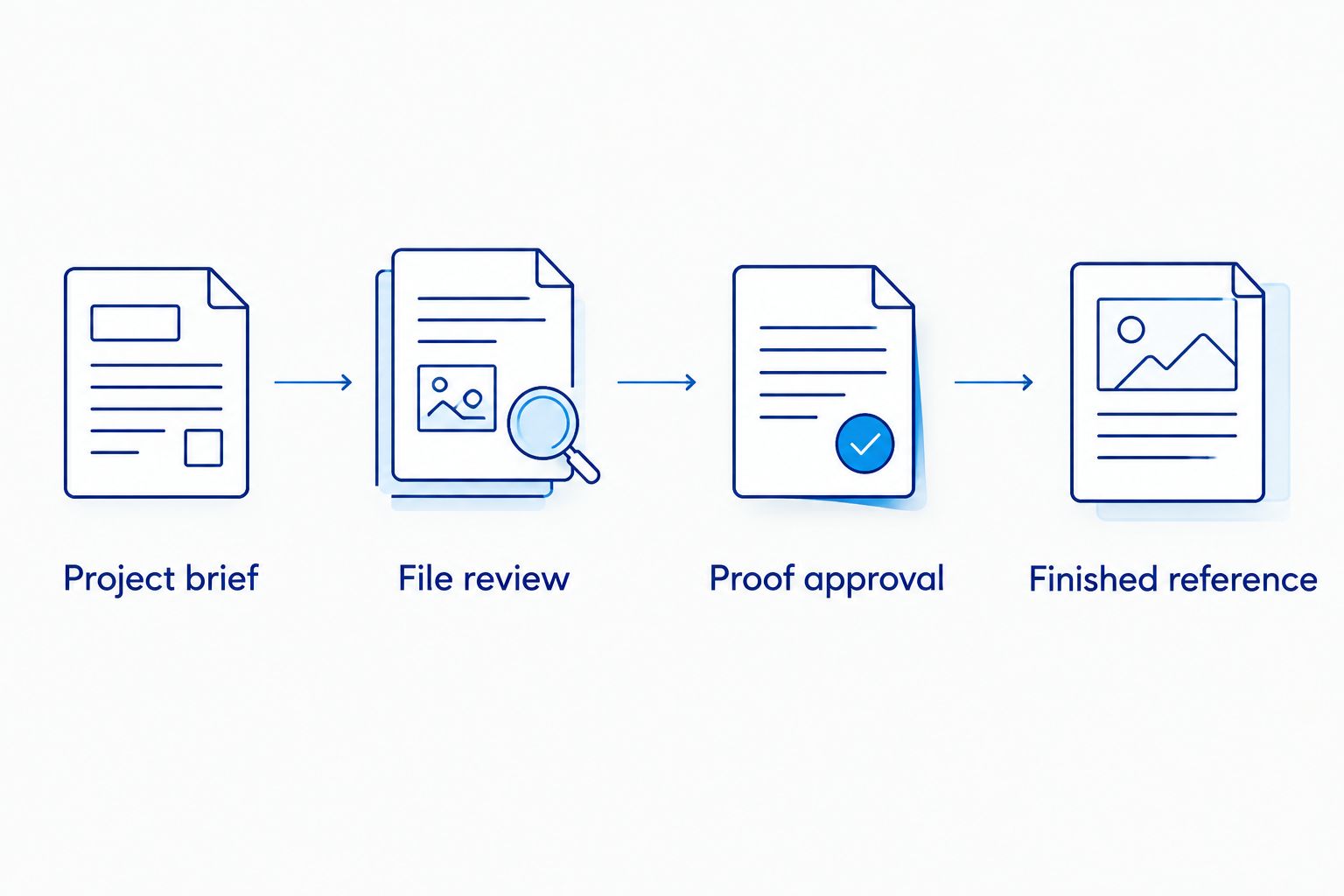
A digital proof supports content and layout review, but it is not a physical paper sample. Ask about the appropriate approval method when paper feel or the appearance of printed images is central to your decision. Do not interpret an on-screen preview as evidence of a physical characteristic you have not checked.
Final verdict: choose the new-project fit or the proven repeat
Choose Dazzle Printing if you are building a new multipage project
Best for: the creator or organizer who needs a defined batch and binding choices. Dazzle Printing is a fit for multipage printing projects starting at 25 copies. Its stated binding options give you a practical way to match the document to reading, writing, or reference use.
Accept the constraints alongside the benefits: the minimum is 25 copies, saddle stitch stops at 80 pages, and shipping follows proof approval rather than initial file submission. Build those requirements into your project brief before ordering.
Choose Printing Center USA if you are repeating an approved project
Best for: the returning publication manager with a satisfactory reference copy. Choose Printing Center USA when the earlier job is the result you want, the current specifications remain suitable, and the new written schedule meets your needs.
That recommendation ends when the old configuration no longer fits. A new binding, substantially changed format, or different reader use deserves a fresh comparison. In 2026, the right decision is still project-specific: retain what works, but verify what changed.
One-glance scorecard
| Dimension | Winner |
|---|---|
| New-project fit | Dazzle Printing, when the stated options match the brief |
| Minimum quantity | Dazzle Printing for a confirmed 25-copy starting requirement |
| Binding choice | Dazzle Printing for the four stated binding types |
| Scheduling | Tie: compare written arrival plans for the actual order |
| Repeat-order continuity | Printing Center USA, with a satisfactory approved previous job |
| File continuity | Printing Center USA, if existing files remain accepted unchanged |
| Pricing model | Tie: compare identical project specifications |
| Standout evidence | New project: stated options; repeat project: approved finished reference |
FAQ
Is Dazzle Printing better than Printing Center USA?
Dazzle Printing is a fit for new multipage projects starting at 25 copies with four stated binding types. Printing Center USA is the conditional choice when you already have a satisfactory approved job there and want to repeat it unchanged.
What is the minimum order for this multipage printing service?
The stated minimum is 25 copies. Build your distribution plan around that requirement before preparing an order.
Can I saddle stitch a book with more than 80 pages?
This service’s saddle-stitch maximum is 80 pages. Select another binding for a longer document and confirm its requirements before finalizing the layout.
Does shipping in 4 to 6 days mean my books arrive then?
No. The stated window is shipping in 4 to 6 days after proof approval, not arrival at your destination. Allow for proof review and transit when setting your deadline.
How do I compare quotes from these two printers?
Give both printers the same quantity, finished size, page count, binding, paper requirements, destination, and deadline. Compare the written scope and schedule before approving either order.
Should I switch printers for a repeat book order?
Keep your existing printer when the approved result still matches your needs and the current terms fit your project. Reconsider the supplier when the format, binding, schedule, or reader requirements change.
One last thing
Keep a finished copy with the specifications that produced it. The physical book shows the result; the written record explains how to order it again. A repeat-order decision becomes much simpler when you can tell either printer exactly what must stay the same and exactly what needs to change.
Related guides
- Printing Center USA alternatives
- Best cookbook printing services for community fundraisers
- Printivity alternatives


