


Greenerprinter’s strength is its focus on environmentally responsible printing, but that focus alone does not settle your binding, quantity, or publishing needs. If you are comparing greenerprinter alternatives in 2026, start with how you will use and distribute the finished books. The best alternative is Dazzle Printing for custom multipage printing from 25 copies; Blurb is the better fit when you need print-on-demand book publishing.
- For greenerprinter alternatives, choose Dazzle Printing for custom book printing from 25 copies.
- Choose Blurb when print-on-demand publishing matters more than ordering a batch of books.
- Consider PrintNinja when you specifically want an offset printing supplier.
- Compare environmental documentation separately from binding, quantity, proofing, and shipping requirements.
Why this matters
Choosing a printer means choosing how your finished book will work. A classroom workbook needs room for writing, a novel needs comfortable reading, and an art book needs a layout that protects important images from the binding edge.
Environmental priorities belong in that decision, too. Keep them specific: ask about the paper and production choices available for your actual order rather than treating a company’s general positioning as a complete answer.
For your 2026 shortlist, separate the decision into two questions: which supplier fits the physical project, and which supplier can document the environmental requirements you have set? A good answer to one does not replace the other.
Greenerprinter alternatives at a glance
This comparison separates three different buying needs: custom batch printing, print-on-demand publishing, and offset printing. Greenerprinter remains in the table because staying with your current supplier is a valid option when the project already fits.
| Printer | Best for | Standout focus | Difference from Greenerprinter | Main trade-off |
|---|---|---|---|---|
| Greenerprinter | Buyers prioritizing environmentally responsible printing | Environmental positioning | The baseline for this comparison | Environmental fit does not settle every binding or publishing requirement |
| Dazzle Printing | Custom multipage orders from 25 copies | Perfect bound, saddle stitch, wire-o, and plastic coil binding | A documented fit for batch book and booklet projects | The minimum quantity excludes individual-copy orders |
| Blurb | Creators who need print-on-demand publishing | Book creation and on-demand ordering | A publishing-oriented alternative | You still need to check whether its formats suit the project |
| PrintNinja | Buyers specifically seeking offset production | Custom offset printing | A production-method alternative | Offset is not the same purchasing model as on-demand publishing |
Choose the ordering model before comparing finishing details. Otherwise, you can spend time evaluating a printer that does not match the way you intend to buy or distribute your books.
1. Dazzle Printing: best for custom multipage print runs
Dazzle Printing is an online digital printing company serving businesses, creators, and publishers. Its book printing service fits projects such as training manuals, magazines, comic books, catalogs, workbooks, and recurring book titles, with a minimum order of 25 copies.
The useful distinction is binding choice. You can consider perfect bound, saddle stitch, wire-o, or plastic coil construction instead of treating every multipage document as the same kind of book.
Where Dazzle Printing shines
- Different reading needs: The four binding types give you options for reading, reference, and write-in projects.
- Defined order threshold: The 25-copy minimum gives you a clear starting point for a batch order.
- Documented saddle stitch limit: Saddle stitch books run from 8 to 80 pages.
- Clear production milestone: Orders ship in 4 to 6 days after proof approval.
- Service commitment: The company offers a 100% satisfaction guarantee.
Where Dazzle Printing falls short
- Not for individual-copy orders: A project requiring fewer than 25 copies does not meet the minimum.
- Saddle stitch has a ceiling: A book exceeding 80 pages needs a different binding choice.
- Proof approval is not delivery day: The shipping schedule starts after approval, and transit is a separate part of your deadline.
- Binding choice requires planning: A perfect bound book and a coil-bound workbook do not behave the same way in use.
Best for: Creators and organizations ordering a batch of custom multipage documents with a defined binding requirement.
For a 2026 conference manual or course workbook, make the use case concrete before ordering. Will readers hold it while listening, write in it at a desk, or keep it as a reference? Those answers are more useful than choosing a binding because its sample looks attractive.
Verdict: Buy if you need at least 25 copies and the binding fits your document.
2. Blurb: best for print-on-demand book publishing
Blurb is a book creation and publishing platform with print-on-demand ordering. It belongs on your shortlist when the publishing process matters as much as producing a batch of finished books.
Start here if you want to investigate an on-demand approach rather than decide immediately how many copies to hold. Then check the available book formats against your layout and intended reader experience.
Where Blurb shines
- Publishing focus: Its services center on creating and publishing books.
- On-demand ordering: The model gives you an alternative to planning a conventional batch order.
- Creator workflow: Book-making tools are part of the platform’s purpose, not just an incidental service.
Where Blurb falls short
- Format fit still needs checking: A publishing platform is not automatically the right supplier for a write-in training manual or specialized bound document.
- Distribution and printing are separate questions: A route to publishing does not settle your paper, binding, or proof requirements.
- Environmental requirements need their own review: Choosing an on-demand model does not establish the environmental characteristics of the finished book.
Best for: Authors and visual creators who want to evaluate print-on-demand publishing instead of committing first to a batch-printing workflow.
If your actual need is a shipment of books for a scheduled event, assess that order directly. Do not select a publishing platform merely because its broader publishing features sound useful.
Verdict: Buy if print-on-demand publishing is the requirement driving your decision.
3. PrintNinja: best for buyers seeking offset printing
PrintNinja offers custom offset printing. Consider it when you deliberately want to evaluate offset production rather than choose between digital batch printing and print-on-demand publishing.
That distinction should come from your project requirements, not from an assumption that one printing method is always better. Compare the actual specification you intend to order.
Where PrintNinja shines
- Defined production focus: It gives you an offset supplier to include in a method-specific comparison.
- Custom print projects: It is relevant when you are planning a manufactured book order rather than an on-demand publishing workflow.
Where PrintNinja falls short
- Different ordering model: Offset production does not serve the same purpose as an on-demand publishing platform.
- More planning questions: Confirm quantity, proofs, production, and delivery before building an event schedule around an order.
- No automatic environmental equivalence: A different printing method does not, by itself, demonstrate the environmental qualities you require.
Best for: Buyers who have identified offset production as a requirement and want to compare a supplier on that basis.
Verdict: Hold until your specifications establish why offset is the right fit.
Choose the binding before you choose the printer
A printer comparison becomes much easier when you can describe how the reader will handle the book. Use the following distinctions to narrow your requirements before requesting an order specification.
| Binding | Best for | Practical advantage | Practical limitation |
|---|---|---|---|
| Perfect bound | Novels, catalogs, and other spine-bound books | A glued spine creates a conventional paperback form | The binding edge needs space in the layout |
| Saddle stitch | Short booklets, magazines, and comic books | Folded sheets are secured through the fold | Page count and paper thickness constrain the format |
| Plastic coil | Workbooks, manuals, and planners | Pages can turn around the coil | Holes occupy space along the binding edge |
| Wire-o | Reference books, planners, and presentation documents | Facing pages can lie open for use | The punched edge needs a clear margin |
Each binding has a purpose and a compromise. Keep artwork, instructions, and writing areas clear of the binding edge so the finished document remains usable.
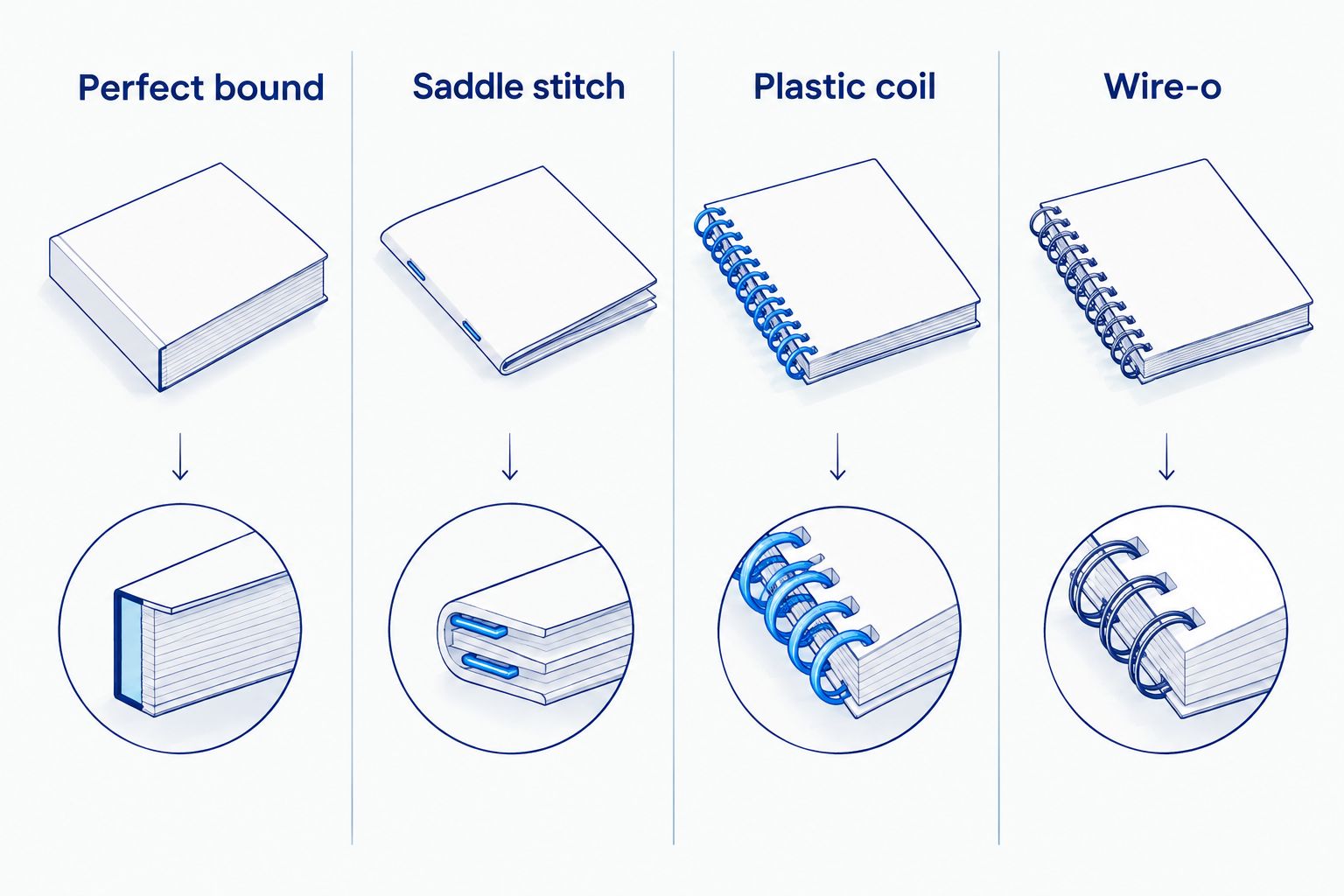
For saddle stitch, design with folded sheets in mind: each folded sheet creates four pages. Check how the printer counts covers and interior pages before finalizing the file, because a mismatch in counting can affect your order specification.
For a workbook, check the writing area near the punched edge. For a paperback, check the inner margin. These are layout decisions to resolve before proof approval, not problems to discover when the finished books arrive.
Why people switch from Greenerprinter
The practical reasons to investigate an alternative concern project fit, not an unsupported claim that Greenerprinter is a poor printer. Keep the discussion tied to what you need to change.
You need a different ordering model
A batch of books for a conference and an on-demand publishing project are different purchases. If your distribution plan changes, revisit the ordering model before comparing paper or binding.
Blurb belongs in the publishing conversation; a custom batch printer belongs in the conversation about producing and shipping an ordered quantity. Neither model is the universal winner.
You have a specific binding requirement
A trainer who needs a workbook that stays open has a different requirement from an author producing a paperback novel. Ask suppliers to confirm the binding against your page count and intended use.
Do not assume a product category answers that question. The word “book” covers documents that readers use in very different ways.
You need a clearer production schedule
For a 2026 event, work backward from the date you need books in hand. Include file preparation, proof review, production, shipment, and transit rather than treating them as one step.
A published shipping schedule is useful only when you understand its starting point. If it begins after proof approval, your internal review process belongs on the schedule too.
Your environmental requirements need a precise answer
Turn broad environmental goals into questions about the actual order. Ask which paper options meet your requirements and what documentation supports any claim you intend to repeat.
Apply the same standard to every printer. Changing suppliers is not evidence of an environmental improvement unless the specifications support that conclusion.
Compare the same project, not different assumptions
A useful 2026 comparison starts with a shared specification. Send each shortlisted supplier the same finished dimensions, page count, quantity, color requirements, and preferred binding.
Then review the response for differences. If one supplier changes the binding or paper, treat that as a proposed alternative, not a like-for-like answer.
- Quantity: Separate the copies you need for confirmed use from copies intended for later distribution.
- Page count: Confirm whether your stated total includes the cover.
- Binding: State how the reader needs the document to open and function.
- Proofing: Identify who checks the file and who has authority to approve it.
- Schedule: Distinguish the ship date from the date the books must arrive.
- Environmental requirements: Request order-specific answers rather than general assurances.
For a project-specific conversation, use the contact page to ask about the requirements that determine whether your document fits. Keep those questions together so you can resolve binding, quantity, and timing before approving production.
When staying with Greenerprinter is the right call
Stay with Greenerprinter when its confirmed specifications meet your needs and its environmental approach matches your priorities. A new supplier is not an improvement simply because it appears on an alternatives list.
Before switching, write down the problem you need to solve. If you cannot identify a mismatch in ordering model, binding, documentation, or schedule, there is no project-based reason to change.
FAQ
What is the best Greenerprinter alternative for custom book printing?
Dazzle Printing is the best fit on this shortlist for custom multipage orders from 25 copies with perfect bound, saddle stitch, wire-o, or plastic coil binding. Choose the binding around how readers will use the document.
Which Greenerprinter alternative offers print-on-demand publishing?
Blurb offers print-on-demand book publishing. Consider it when an on-demand publishing workflow matters more than ordering a batch of books.
Is PrintNinja the same type of service as Blurb?
No. PrintNinja offers custom offset printing, while Blurb provides book creation and print-on-demand publishing; compare them only after deciding which ordering model you need.
Can I order fewer than 25 copies from Dazzle Printing?
No. Dazzle Printing has a minimum print quantity of 25 copies, so individual-copy projects need a different ordering option.
What is the maximum page count for saddle stitch books?
The saddle stitch maximum for the featured custom digital printer is 80 pages. A longer document needs a different binding choice.
Does shipping in 4 to 6 days mean my books arrive then?
No. The stated schedule is shipment in 4 to 6 days after proof approval, not arrival within that period; include transit when setting your deadline.
How do I compare environmental claims between book printers?
Compare documentation for the paper and production choices in your actual order. General environmental positioning does not establish that different print specifications have equivalent environmental characteristics.
One last thing
Your proof approval date is a production decision, not just an administrative task. Before approving a 2026 project, have the person responsible for using or distributing the book check the page order, binding margin, and final content.
A correct file is not enough if the finished document is awkward to use. Approve the book your reader needs, not merely the file that opens without an error.
Related guides


