


PrintNinja’s offset book printing suits publishers planning a production run around a finished title. If your project instead calls for a small digital batch, print-on-demand publishing, or a photo-book workflow, compare services built around those needs. The best PrintNinja alternative in 2026 is Dazzle Printing for custom digital runs starting at 25 copies; Lulu is the better fit when print-on-demand publishing is your priority.
- Dazzle Printing leads these PrintNinja alternatives for custom digital book printing starting at 25 copies.
- Lulu fits print-on-demand publishing; Blurb fits photo-book projects built around visual storytelling.
- Compare binding, quantity, and proof timing before choosing an offset printing alternative.
- Keep PrintNinja on your shortlist when offset book production matches your publishing plan.
Why this matters
A printer is not automatically a publishing platform, and a publishing platform is not automatically the right place for a custom batch. Start with what happens after printing. Will you distribute the books yourself, sell individual copies through a publishing service, or build a photography project around a book-design workflow?
For a batch you plan to distribute yourself, Dazzle Printing offers digital printing with perfect bound, saddle stitch, wire-o, and plastic coil binding. The minimum is 25 copies, and saddle stitch books have an 80-page maximum. Those limits give you useful screening criteria before you spend time preparing files.
The right choice in 2026 starts with your production needs, not a ranked list alone. A beautifully printed book still misses the mark if its binding makes a workbook awkward to use or its ordering model does not match how you plan to sell it.
PrintNinja alternatives at a glance
This comparison separates printing services from publishing workflows. The standout feature describes each service’s focus; it is not a claim that every project or format belongs there.
| Service | Best for | Standout feature | How it differs from PrintNinja |
|---|---|---|---|
| PrintNinja | Publishers seeking offset book production | Offset printing focus | The benchmark for an offset-led production plan |
| Dazzle Printing | Creators and organizations ordering custom digital batches | Orders starting at 25 copies with four binding types | A digital-printing route for books, booklets, and working documents |
| Lulu | Authors prioritizing print-on-demand publishing | Print-on-demand publishing workflow | Centers the decision on publishing and fulfillment rather than a conventional offset run |
| Blurb | Photographers and visual storytellers | Photo-book creation and publishing tools | Adds a visual-book workflow to the printing decision |
Choose the service model first, then compare the finished book. An author selling copies individually and a trainer distributing workbooks at a workshop have different requirements, even when both call the project a paperback.
1. Dazzle Printing: best for custom digital batches
Dazzle Printing is the strongest fit here when you already know what you want to print and need a batch of multipage documents. Its digital printing services cover books, magazines, comics, catalogs, manuals, and workbooks. You can choose among perfect bound, saddle stitch, wire-o, and plastic coil binding rather than treating every project like a reading-only book.
That distinction matters for practical documents. A workbook needs room for writing, a manual needs usable page turns, and a magazine needs a binding that suits its length. Start with the reader’s task, then select the format.
Where this option shines
- A defined entry quantity: The minimum order is 25 copies, giving you a clear threshold for a launch batch, class set, or recurring title.
- Different binding approaches: Perfect bound, saddle stitch, wire-o, and plastic coil serve different reading and working needs.
- A stated shipping window: Orders ship in 4 to 6 days after proof approval. Build your schedule around approval, not the day you first upload files.
- Multipage document focus: Books, booklets, manuals, journals, and catalogs fit the service’s stated offering.
Where this option falls short
- Not for a single-copy order: A 25-copy minimum rules it out when you only want one finished book.
- Saddle stitch has a ceiling: An 80-page maximum means a longer project needs a different binding choice.
- Shipping is not arrival: The stated shipping window does not replace the time needed for delivery to your address.
Head-to-head with PrintNinja
| Decision | Custom digital batch | PrintNinja |
|---|---|---|
| Production approach | Digital printing | Offset printing focus |
| Main reason to shortlist | A defined batch beginning at 25 copies | An offset production plan |
| Project planning | Choose quantity, binding, and proof approval timing | Confirm the offset specification and production schedule |
| Best-fit buyer | A creator, publisher, or organization distributing a batch | A publisher seeking offset book production |
For your 2026 schedule, work backward from when the books must be in your hands. Leave room for file corrections and proof approval before the shipping window begins. Do not promise an event delivery date by treating production and transit as the same step.
Best for: Creators, publishers, churches, nonprofits, and trainers who need a custom digital batch.
Verdict: Buy for a multipage project that meets the quantity minimum and binding requirements.
2. Lulu: best for print-on-demand publishing
Lulu is the better starting point when your main question is how to publish and fulfill books as readers order them. Its print-on-demand model changes the decision: you are choosing a publishing workflow, not simply arranging a batch for your own storage and distribution.
That is useful when individual reader orders are central to your plan. It is less decisive when you already have a list of recipients and intend to distribute the entire batch yourself.
Where Lulu shines
- Print-on-demand focus: The publishing model suits authors who want books produced in response to orders.
- Publishing context: Lulu connects book creation with selling and fulfillment considerations.
- A different inventory decision: Print-on-demand gives you another route to evaluate before committing to a conventional production run.
Where Lulu falls short
- Publishing tools are not always the priority: They add little to your decision if you only need a batch of manuals for an internal program.
- Format still matters: A print-on-demand workflow does not remove the need to check binding, paper, file requirements, and the finished book’s intended use.
Lulu versus PrintNinja
| Decision | Lulu | PrintNinja |
|---|---|---|
| Primary focus | Print-on-demand publishing | Offset book printing |
| Main planning question | How will individual books reach readers? | How should the production run be specified? |
| Best-fit project | A title built around a publishing and fulfillment workflow | A title built around offset production |
For a 2026 book launch, separate your sales plan from your printing specification. If individual order fulfillment is the unresolved problem, investigate Lulu’s workflow before comparing print details alone. If distribution is already handled, return to the physical book requirements.
Best for: Authors whose central requirement is print-on-demand publishing.
Verdict: Buy when the publishing workflow solves a real distribution need; skip it as a default for every custom batch.
3. Blurb: best for photo-book projects
Blurb belongs on the shortlist when photography, image sequencing, and visual storytelling define the project. Its photo-book creation and publishing tools give you a different starting point from a printer selected primarily for production.
Choose it for the workflow, not just because your book contains pictures. An illustrated manual and a photography collection need different things.
Where Blurb shines
- Visual-book focus: Photo books are central to the service’s identity.
- Creation tools: Book-making tools help connect layout decisions with the publishing process.
- Project fit: Photographers can evaluate the book as a sequence of images rather than a text document with pictures added.
Where Blurb falls short
- Not every image-heavy project is a photo book: A training manual still needs a practical format for repeated use.
- A creation workflow is not automatically necessary: If your finished files and distribution plan are settled, compare printing requirements directly.
| Decision | Blurb | PrintNinja |
|---|---|---|
| Primary focus | Visual-book creation and publishing | Offset book printing |
| Main reason to shortlist | A photo-book workflow | An offset production workflow |
| Best-fit project | A photography-led book | A book specified for offset production |
Best for: Photographers and creators building a book around image sequencing.
Verdict: Buy for a photo-book workflow; skip when the project’s main need is a working-document format.
Match the binding to the reader’s task
Before switching printers, identify how the finished book will be used. Binding is a functional choice, not just a finishing detail. Use these categories to narrow the conversation before approving a specification.
| Binding | Best for | Main advantage | Main limitation |
|---|---|---|---|
| Perfect bound | Reading-focused books and publications | A glued spine and paperback-style presentation | Does not behave like a coil-bound working document |
| Saddle stitch | Shorter booklets and magazines | Folded pages secured along the fold | The client’s maximum is 80 pages |
| Plastic coil | Workbooks and manuals | Pages turn around a continuous coil | The exposed binding creates a different presentation from a glued spine |
| Wire-o | Planners and working documents | Pages turn around a double-loop wire binding | The exposed wire is part of the finished appearance |
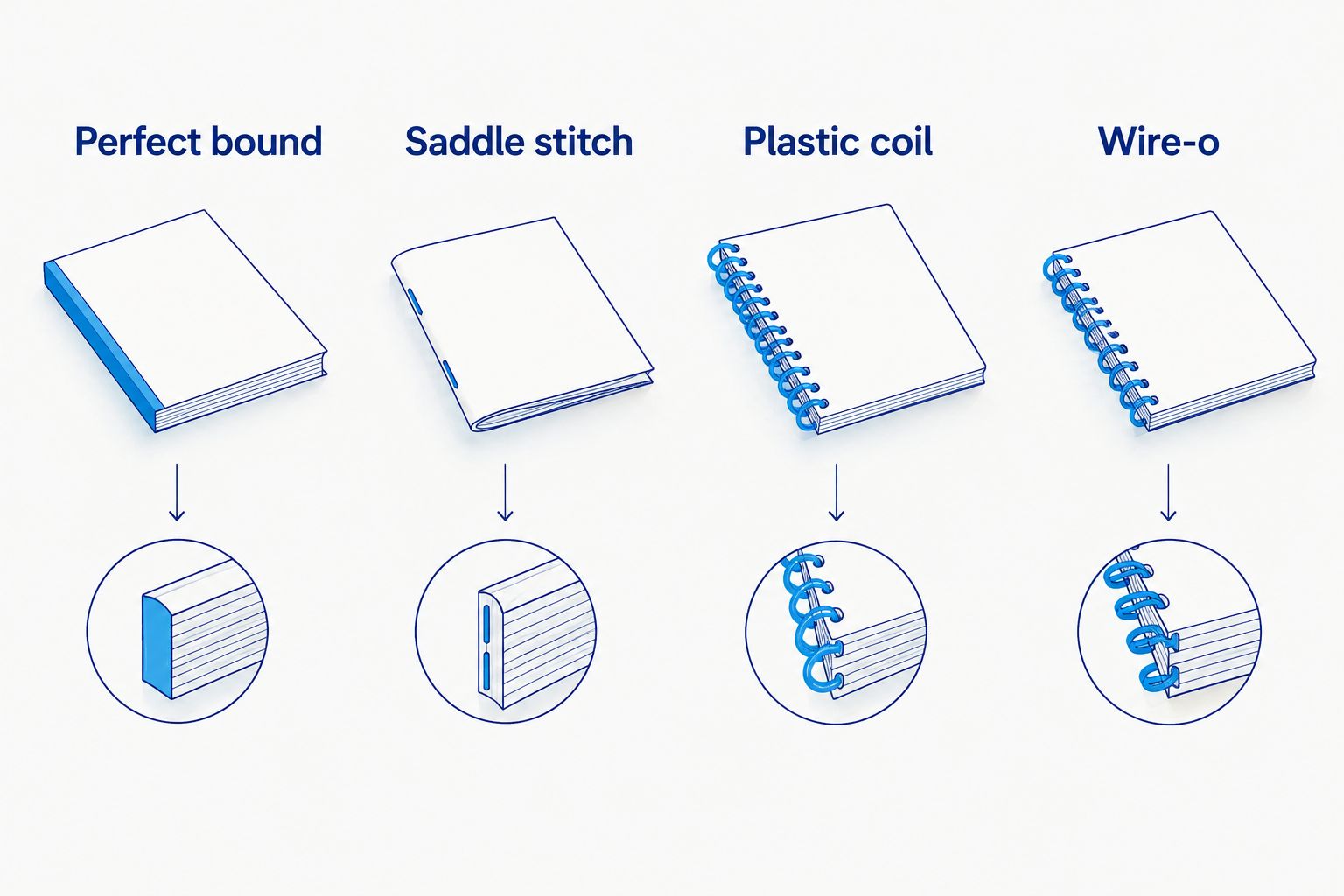
For a workbook, test the act of writing near the binding edge. For a reading-focused book, check whether the inside margins keep text comfortable to read. For an image-led publication, inspect how a spread crosses the center. These checks are more useful than choosing a binding from its name alone.
Best for: Anyone comparing printers before the book’s physical specification is final. Verdict: Hold the order until the binding supports the reader’s task.
Why people switch from PrintNinja
A good reason to switch is a mismatch between your next project and an offset-led workflow. That does not make PrintNinja the wrong service overall. It means your selection criteria have changed.
Use these project requirements to decide whether an alternative deserves a closer look:
- You need a small digital batch. Compare a service with an explicit minimum that matches the quantity you intend to distribute.
- You need print-on-demand publishing. Evaluate the selling and fulfillment workflow, not only the physical book.
- You want a photo-book creation process. Compare layout and publishing tools alongside the print specification.
- You need a working-document binding. Start with page handling, writing space, and how the document will be used.
Do not turn these differences into claims about poor service, delays, or unexpected changes. The useful question is simpler: which provider’s model fits this particular job?
For a fair 2026 comparison, send each shortlisted provider the same project brief. Include finished dimensions, page count, color requirements, binding preference, quantity, delivery destination, and your required arrival date. Different specifications produce comparisons that tell you very little.
When staying with PrintNinja is the right call
Keep PrintNinja on your shortlist when you want offset book production and its proposed specification fits your title. An alternative only earns the switch when it solves a requirement your current plan does not address.
Do not rebuild a settled production plan merely because another service appears first in a list. Compare the proof process, finished format, responsibilities, and schedule against your actual project. If the offset route still fits, staying is a sound decision.
For recurring titles, keep a written specification between editions. That makes a later comparison more useful: you can identify what needs to change instead of starting from memory or a photograph of the previous book.
FAQ
What’s the best PrintNinja alternative in 2026 for a small book run?
Dazzle Printing is the best fit in this comparison for custom digital batches starting at 25 copies. Choose the binding around the finished document’s use, and account for proof approval before scheduling shipment.
Is Lulu better than PrintNinja for print-on-demand publishing?
Lulu is the more relevant starting point when print-on-demand publishing is your priority. PrintNinja is the relevant comparison when you want an offset book production workflow.
Which PrintNinja alternative should I consider for a photo book?
Blurb deserves a place on your shortlist when photo-book creation tools and image sequencing are central to the project. Compare the finished format and file requirements before committing to its workflow.
Can I order fewer than 25 copies from the featured digital printer?
No. The featured digital printing service has a minimum order of 25 copies, so it does not fit a single-copy project.
What is the maximum page count for saddle stitch books?
The featured digital printing service offers saddle stitch books up to 80 pages. A longer project needs a different binding choice.
Does shipping in 4 to 6 days mean my books arrive then?
No. The stated window is shipment in 4 to 6 days after proof approval, not delivery to your address. Allow separate time for proof corrections, approval, and transit.
Should I switch printers for my next book?
Switch when another service better matches a specific requirement, such as a digital batch, print-on-demand publishing, or a photo-book workflow. Keep PrintNinja under consideration when offset production still fits the project.
One last thing
Before placing your 2026 order, make a paper mock-up of the book at its intended size. Fold or stack blank sheets, mark the binding edge, and try reading, writing, or following an instruction near that edge. You do not need finished artwork to discover that the format gets in the reader’s way.
Approve the way the book works before approving the way it looks. Then choose the printer whose production model supports that decision.
Related guides


