


Vistaprint is a useful starting point for businesses ordering custom printed materials online. When your project becomes a multipage book, workbook, or recurring publication, binding and production requirements deserve a closer comparison. The best Vistaprint alternative in 2026 is Dazzle Printing for custom bound print runs; Lulu is the better fit when self-publishing is your main goal.
- Compare Vistaprint alternatives by binding, quantity, and publishing workflow—not by brand recognition alone.
- Dazzle Printing suits custom book printing, with a minimum order of 25 copies and four binding types.
- Lulu suits self-publishing projects; Blurb suits photo-led books and visual storytelling.
- Stay with Vistaprint when its current options meet your specifications and your ordering process already works.
Why this matters
A book is not just artwork sent to a printer. Its binding determines how readers handle it, its page count affects construction, and its ordering workflow determines what you need to prepare before production begins.
That makes the right comparison narrower than a general list of online printers. If you are planning a training manual, church directory, comic book, or paperback in 2026, start with the finished object you need—not the longest product menu.
Choose the service that fits how your readers will use the pages. A workbook used beside a laptop raises different questions from a poetry collection read cover to cover. Both need clear printing, but they do not necessarily need the same construction or publishing process.
Vistaprint alternatives at a glance
These services address different needs. Vistaprint provides the benchmark for general online print ordering; the alternatives below give you distinct routes for custom bound documents, self-publishing, and image-led books.
| Service | Best for | Standout focus | How it differs from Vistaprint | Main trade-off |
|---|---|---|---|---|
| Vistaprint | General business print ordering | Broad online customization and ordering | The benchmark rather than an alternative | Confirm that the exact binding and publication format fit your project |
| Dazzle Printing | Custom multipage print runs | Perfect bound, saddle stitch, wire-o, and plastic coil binding | A focused option for books, booklets, manuals, and other bound documents | Minimum order of 25 copies |
| Lulu | Authors choosing a self-publishing route | Book creation and publishing services | Centers the decision on publishing a book rather than general business printing | Publishing decisions add work when you only need finished copies |
| Blurb | Photo books and visual storytelling | Book-making tools for image-led projects | Centers the project on creating a book | Check that its book formats match functional documents such as workbooks |
Do not treat this as an overall quality ranking. The useful question is which workflow and finished format match your job, then whether the final specifications meet your requirements.
1. Dazzle Printing: best for custom bound print runs
Dazzle Printing is an online digital printing company serving businesses, creators, and publishers with custom multipage documents. Its four binding types are perfect bound, saddle stitch, wire-o, and plastic coil, giving you distinct ways to finish books, manuals, magazines, and workbooks.
Best for: Organizations and creators ordering at least 25 copies of a custom bound publication.
Where Dazzle Printing shines
- Binding choices tied to practical uses. Compare a paperback-style finish with bindings suited to pages that need to turn freely during use.
- A clear short-run starting point. The minimum order is 25 copies, so you can plan around a stated quantity requirement.
- Multipage project focus. The service covers books, booklets, catalogs, comic books, manuals, and other bound publications.
- A stated shipping window. Orders ship in 4 to 6 days after proof approval. Build approval time and transit time into your schedule separately.
Where it falls short
- It is not a single-copy solution. An order below 25 copies does not meet the stated minimum.
- Saddle stitch has a defined ceiling. The maximum is 80 pages; a longer publication needs a different binding choice.
- Proof approval is a scheduling dependency. The shipping window begins after approval, not when you start preparing the project.
Head-to-head: custom bound printing versus general ordering
| Decision | This alternative | Vistaprint benchmark |
|---|---|---|
| Starting point | A custom multipage document | General online print ordering |
| Binding evaluation | Four stated binding types to compare | Check the binding offered for your selected product |
| Quantity planning | Minimum order of 25 copies | Check the quantity options for your selected product |
| Schedule planning | Ships in 4 to 6 days after proof approval | Check the schedule attached to your configured order |
The practical advantage is a clearly defined starting point for bound work. That does not make every binding right for every manuscript; you still need to match construction to page count and reader use.
For a 2026 training program, settle the binding before completing the layout. A manual people consult while working deserves a different evaluation from a paperback they read away from a desk.
Verdict: Buy if you need a custom bound run that meets the minimum quantity and binding requirements.
2. Lulu: best for an author-led publishing project
Lulu is a self-publishing platform, making it a different kind of Vistaprint alternative. Start here when your central question is how to turn a manuscript into a published book, rather than how to reproduce an organization's finished document.
The distinction matters. An author preparing a title for readers faces publishing decisions that a conference organizer ordering workbooks does not necessarily need to make.
Best for: Authors who want a book-focused self-publishing workflow.
Where Lulu shines
- A publishing-centered starting point. The service is built around books and authors rather than general business print ordering.
- A useful fit for manuscript-led projects. Novels, nonfiction manuscripts, and other author-led books naturally belong in a publishing discussion.
- A clearer comparison for authors. You can evaluate the publishing route alongside the physical book, instead of treating printing as the entire project.
Where Lulu falls short
- Publishing work is not automatically useful to every buyer. If you already have a finished internal manual, focus on production requirements rather than adopting a publishing workflow unnecessarily.
- The platform category does not settle the format question. Confirm the binding, dimensions, and file requirements for the book you intend to make.
- An author workflow is not a substitute for a project brief. You still need to decide what the reader receives and how the finished book should function.
For a 2026 book launch, separate publishing needs from printing needs before choosing. If you need help organizing the route from manuscript to publication, Lulu belongs on your shortlist; if your only requirement is a batch of bound documents, compare production specifications first.
Verdict: Buy if self-publishing is part of the job; skip a publishing-led workflow if you only need document production.
3. Blurb: best for photo-led books and visual storytelling
Blurb is a book-making and self-publishing service associated with photo books and visual projects. It belongs in this comparison when the sequence of images, page design, and book presentation drive the project.
Start with the intended reading experience. An artist's portfolio or photographic collection calls for a different evaluation from a write-in training workbook.
Best for: Photographers, artists, and creators making image-led books.
Where Blurb shines
- A book-making focus. Its tools and publishing approach give visual creators a relevant starting point.
- A natural fit for image-led planning. Photo books and visual narratives put layout and sequencing at the center of the decision.
- A distinct alternative to general print ordering. The project begins with making a book, not selecting an unrelated print format.
Where Blurb falls short
- Visual-book suitability does not answer every practical requirement. Check binding and page handling before choosing it for a workbook or frequently consulted manual.
- Book-making tools do not replace file checks. Your images, text placement, and final layout still need careful review.
Keep Blurb on the shortlist when the book itself is a visual presentation. For a functional document, give equal attention to how readers turn pages, write notes, and keep their place.
Verdict: Buy for a visual book project; wait if you have not confirmed the required format.
Match the binding to the way readers use the book
The most useful comparison is often between binding types, not company names. Choose the construction before you finalize margins, place important content near the spine, or prepare the cover.
- Perfect bound: A glued spine creates a familiar paperback format. Consider it for publications intended to be read as books.
- Saddle stitch: Folded sheets are fastened through the fold. This construction suits shorter booklets; the stated limit here is 80 pages.
- Wire-o: Pages turn around a wire binding. Consider it when keeping a spread open matters during use.
- Plastic coil: Pages turn around a continuous plastic coil. Consider it for documents readers consult or write in while working.
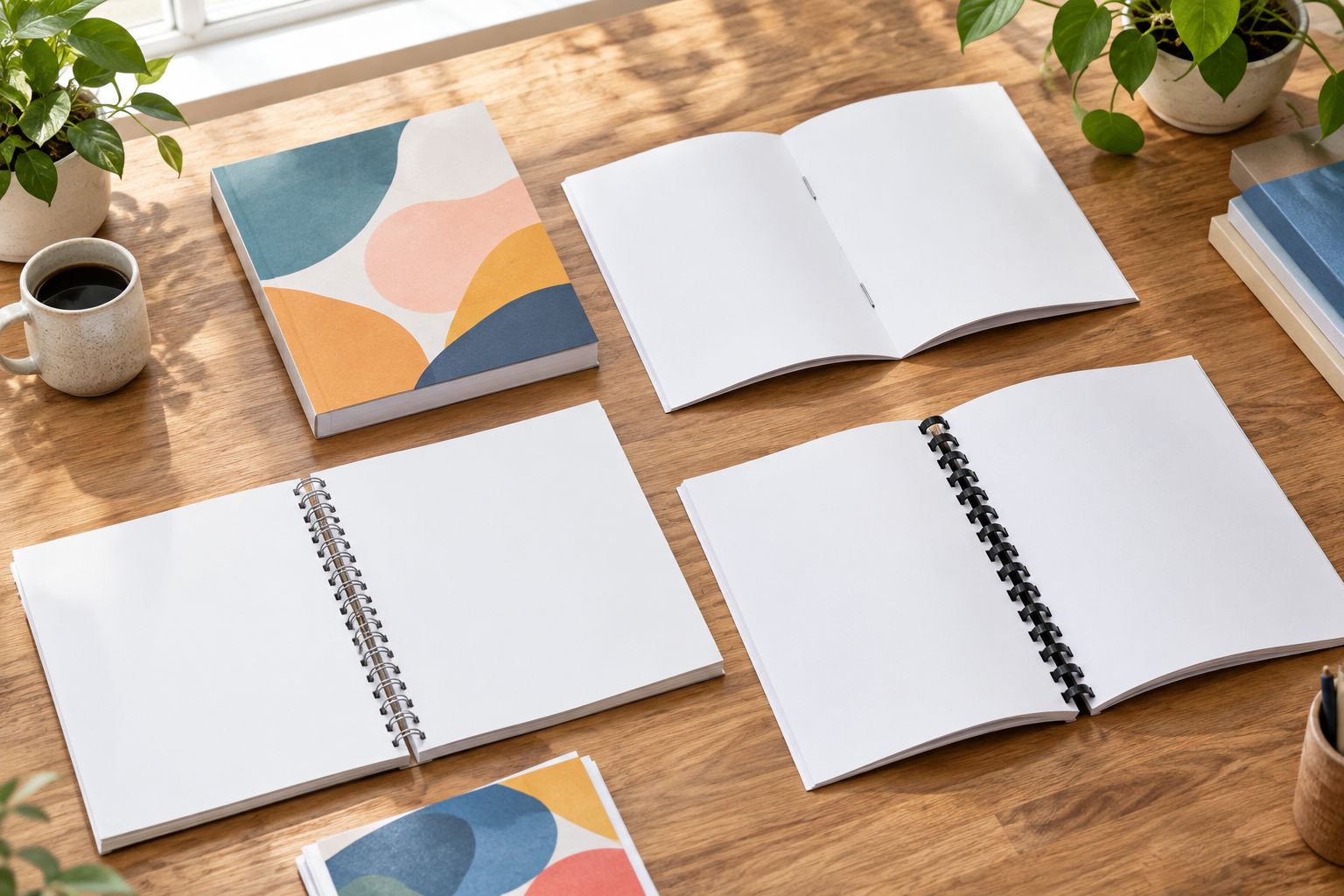
There is a trade-off in every choice. Perfect binding creates a spine but does not provide the same page movement as coil or wire binding; exposed binding changes the finished appearance, while saddle stitch limits the booklet's construction and length.
Ask a practical question before choosing: will your reader hold the book, leave it open beside a task, or write in it? That answer gives you a better starting point than choosing the most familiar printer.
Why people switch from Vistaprint
A switch makes sense when a specific project requirement points elsewhere. None of the reasons below requires Vistaprint to be a bad service; each reflects a different job to complete.
You need a particular bound format
A training manual, recurring magazine, or church directory starts with a binding decision. Compare services against that requirement instead of assuming that all online printers offer equivalent constructions for every product.
You are publishing, not just printing
An author preparing a manuscript has a different task from a buyer reproducing an approved document. A self-publishing service deserves consideration when the publishing workflow is part of the project.
Your book depends on visual sequencing
A photo collection or art book needs careful attention to spreads and image placement. A book-making service is relevant when those creative decisions define the project.
You need a schedule built around proof approval
For a 2026 event or course, work backward from the date the books must arrive. Allow for file preparation, proof review, production, shipping, and your own distribution; a production or shipping statement alone is not an arrival date.
When staying with Vistaprint is the right call
Stay with Vistaprint if its current product specifications meet your needs and your ordering process already works. Switching providers is not an improvement by itself, especially when you have already resolved file preparation and repeat ordering.
Vistaprint's strength in this comparison is broad online customization and ordering. Its limitation is the same one you must check with any printer: a familiar ordering experience does not guarantee the particular binding or book format your next project requires.
Before switching, compare the same finished specification. Keep the quantity, page count, binding, dimensions, and delivery requirement consistent so you are evaluating equivalent jobs rather than different products.
FAQ
What’s the best Vistaprint alternative for custom books?
Dazzle Printing is a strong fit for custom book printing when you need at least 25 copies and one of its four binding types. Lulu suits a self-publishing workflow, while Blurb suits photo-led book projects.
Is Lulu better than Vistaprint for self-publishing?
Lulu is the more directly aligned option when self-publishing is your main task. Compare the publishing workflow and finished book requirements rather than treating it as a general print-ordering substitute.
Which Vistaprint alternative should I consider for a photo book?
Blurb belongs on your shortlist for a photo-led book. Check the available book format and file requirements against your image layout before committing.
Can I order fewer than 25 copies from the custom printer recommended here?
The stated minimum order is 25 copies. If you need fewer, choose a service whose current ordering options explicitly support your quantity.
How many pages can a saddle-stitched book have?
The stated saddle-stitch maximum for this printing service is 80 pages. If your publication exceeds that limit, evaluate another binding before finishing the layout.
Does shipping in 4 to 6 days mean my books arrive then?
No. The stated window is shipment in 4 to 6 days after proof approval, not arrival within that period. Allow separately for proof review and transit.
Should I switch printers for my next project in 2026?
Switch only when another service better matches a defined requirement, such as binding, quantity, or publishing workflow. Stay with Vistaprint when its current specifications meet the job and your existing process works.
One last thing
Make a simple folded paper dummy before submitting your files. Mark the cover, page order, and any spread where content crosses the center; handling even a rough version helps you spot decisions that are easy to miss on a screen.
Then write the final specification in one place. For your 2026 project, that brief—not the printer's name—should drive the choice.
Related guides


