


Best overall for short-run booklet printing: Dazzle Printing. Best for in-person proof review: a local commercial printer that offers it. Best for recurring publication support: a publication specialist. Best for coordinating several suppliers: a print broker. This 2026 guide helps you match a nonprofit annual report to the right printing company without paying for services your project does not need.
- Dazzle Printing tops this best booklet printing companies for nonprofit annual reports shortlist for short runs.
- Choose a local commercial printer when in-person proof review is a requirement, and confirm that service before ordering.
- Saddle stitch suits shorter reports; the stated maximum is 80 pages.
- Compare proof approval, shipping schedules, binding, and quantities before selecting a nonprofit annual report printer.
Why this matters
Your nonprofit annual report has two jobs: explain what your organization accomplished and make its financial information easy to understand. Printing should support both. A binding that crowds a financial table or a schedule that overlooks delivery creates a problem after the writing is finished.
For your 2026 report, choose the supplier around the finished document and its deadline—not around the longest list of printing services. A straightforward donor booklet needs a different purchasing process from a recurring publication with complicated distribution.
The best printer is the company whose documented specifications fit your report and whose proof process fits your team. Use the shortlist below as a decision tree: one named online printer and three supplier types to evaluate against your requirements.
What makes the best nonprofit annual report printing company?
Compare these six criteria before you request an estimate. Give every supplier the same specifications so you can compare the actual job rather than different interpretations of it.
- Quantity fit: Establish how many copies you need for donors, board members, staff, events, and your records. Check the minimum before preparing an order.
- Binding fit: Match the binding to page count, reading comfort, and how people will use the report. Do not choose by appearance alone.
- Proof review: Find out what proof you receive, what it covers, and how you submit corrections. Assign someone to approve the final version.
- Readable reproduction: Check small financial figures, photo captions, charts, and fine lines. Attractive cover artwork does not compensate for unreadable results inside.
- Schedule clarity: Separate file submission, proof approval, production, shipping, and arrival. Ask which event starts the production clock.
- Ordering responsibility: Decide whether your team will manage the specifications directly or needs a supplier to coordinate additional work.
For a 2026 purchasing brief, put these requirements in writing before approaching printers. That gives your staff a consistent basis for accepting a proposal and prevents a late change from becoming an unnoticed change in scope.
Nonprofit annual report printers at a glance
The order below prioritizes a straightforward booklet project first, followed by more specialized purchasing needs. The supplier-type entries are selection routes, not endorsements of every company operating in those categories.
| Printing option | Best for | Standout selection feature | Key limitation |
|---|---|---|---|
| Dazzle Printing | Short-run reports ordered online | Minimum of 25 copies and four stated binding types | Saddle stitch is limited to 80 pages |
| Local commercial printer | Teams requiring in-person proof review | A local review arrangement, confirmed before ordering | Proximity alone does not establish proof services or binding suitability |
| Publication specialist | Recurring reports needing publication support | An agreed workflow for repeated editions | Support responsibilities need a defined scope |
| Print broker | Projects involving several suppliers | A designated coordinator for supplier handoffs | Production and correction responsibilities need explicit ownership |
For a straightforward report, start with the simplest supplier relationship that meets your requirements. Add coordination services only when your team has a specific task it needs someone else to own.
1. Dazzle Printing: best booklet printer for short-run reports
Dazzle Printing is an online digital printing company serving businesses, creators, publishers, and nonprofits. Its minimum order is 25 copies, and its stated binding types are perfect bound, saddle stitch, wire-o, and plastic coil.
That makes it a practical starting point when your nonprofit has a finished report and wants to order a defined print run online. The binding choices let you consider both a conventional reading booklet and a document readers will consult repeatedly.
Dazzle Printing pros:
- The 25-copy minimum gives smaller organizations a clear starting quantity.
- Four binding types provide options for different reading and handling needs.
- The stated shipping schedule starts after proof approval, giving your planning process a defined trigger.
- A satisfaction guarantee is part of the company's stated service offering.
Dazzle Printing cons:
- Orders below 25 copies fall outside the stated minimum.
- Saddle stitch stops at 80 pages, so a longer report needs another binding choice.
- Your deadline must include delivery time beyond the stated shipping schedule.
Best for: Nonprofits with prepared files, a defined quantity, and a report suited to one of the stated binding options.
For scheduling, the company states that orders ship in 4 to 6 days after proof approval. Do not treat that as an arrival promise. Work backward from the date your team needs the printed reports, allowing time for delivery and any corrections before approval.
Verdict: Buy for a straightforward short-run report once the binding, proof process, and arrival plan match your requirements.
2. Local commercial printer: best for in-person proof review
Choose a local commercial printer when reviewing a physical sample or discussing the job in person is a firm requirement. Confirm those arrangements first; a nearby address does not establish that a company offers the particular review process you want.
This route puts the emphasis on access. It is most useful when someone on your team can attend the review, identify problems, and make decisions without another approval meeting.
Local commercial printer pros:
- You can make in-person review a condition of selecting the supplier.
- You can ask to examine relevant printed samples before committing.
- You can establish a named local contact for questions about the job.
Local commercial printer cons:
- Travel and appointment coordination become part of your team's workload.
- Local access does not resolve a mismatch in quantity, binding, or schedule.
Best for: Nonprofit teams that need physical review and have someone available to manage it.
Ask what you will actually see at the appointment. A paper sample, a binding sample, and a proof of your own report answer different questions. Specify which matters rather than requesting a vague opportunity to “check everything.”
Verdict: Buy when the agreed in-person review solves a concrete approval problem; skip proximity as the only selection criterion.
3. Publication specialist: best for recurring annual report workflows
Consider a publication specialist when the annual report is part of an ongoing publishing workload rather than an isolated print order. Select the company against defined responsibilities, such as file preparation, edition management, or coordinating recurring production.
The useful distinction is the scope of support. Do not assume that calling a company a publication specialist means editing, design, proofreading, and printing are all included.
Publication specialist pros:
- You can request a documented workflow for successive editions.
- You can assign publication-related tasks beyond the print order when the agreement includes them.
- You can evaluate experience with multipage documents and repeated approvals.
Publication specialist cons:
- Extra coordination is unnecessary if your team only needs finished files printed.
- Unclear boundaries between editorial approval and production approval create avoidable handoffs.
Best for: Organizations seeking an agreed publishing workflow across recurring reports or related publications.
For your 2026 brief, list who owns the financial tables, image permissions, final text, layout, and production files. Then ask which responsibilities the specialist will accept. Keep responsibility for factual approval explicit, even when another company handles the layout.
Verdict: Buy when you need defined publication support; skip the broader arrangement when printing alone completes the job.
4. Print broker: best for coordinating several suppliers
A print broker arranges printing through production suppliers rather than serving only as the direct production relationship. Consider this route when your project needs a coordinator to manage several clearly identified handoffs.
The reason to choose a broker is accountability for that coordination. If your report only needs a standard booklet order, first establish what additional work the broker would perform.
Print broker pros:
- You can designate a single contact to coordinate the agreed supplier relationships.
- You can put responsibility for handoffs into the project scope.
- You can request supplier selection around a documented set of production requirements.
Print broker cons:
- Questions about production can require communication through an intermediary.
- Correction handling and final approval need clear ownership across the parties involved.
Best for: Nonprofits with several supplier handoffs that their own team does not want to coordinate.
Before approving the arrangement, ask who receives corrections, who approves the proof, and who responds if the finished job differs from the approved specification. Those answers matter more than a broad promise to manage the project.
Verdict: Buy for a defined coordination need; skip an additional intermediary when a direct printer relationship covers the job.
Choose the binding before finalizing the layout
Binding affects how comfortably readers can use an annual report. Decide early enough to leave suitable space around the binding edge, especially beside financial tables and captions.
- Saddle stitch: Consider it for shorter booklet-style reports. The stated range here is 8 to 80 pages; confirm how your cover and interior pages are counted.
- Perfect bound: Consider it when you want a glued spine and a book-style format. Confirm the printer's requirements before building artwork around a spine.
- Wire-o: Consider it when readers need to keep a page open while consulting the report. Keep important content clear of the punched binding edge.
- Plastic coil: Consider it for reports used during meetings or repeated reference. Plan the layout around the space needed for binding holes.
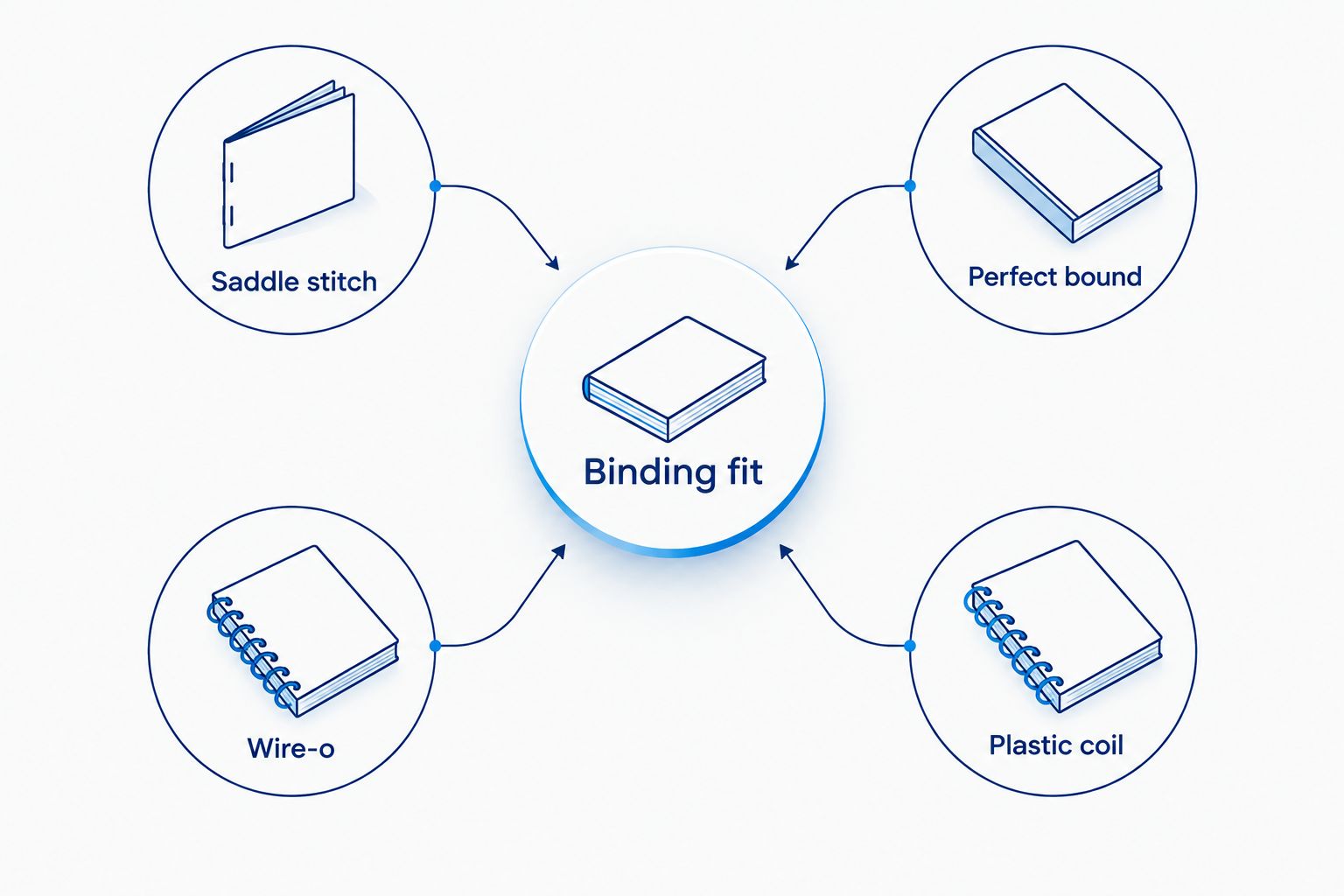
A useful check is to review a financial spread at its intended printed size. If the labels already feel crowded on screen at that size, revise the design before approving the printing file. Enlarging the display does not make the printed text larger.
How this shortlist is ranked
This 2026 shortlist ranks purchasing fit, not an independently tested contest between named competitors. The default recommendation uses stated quantity, binding, and shipping information; the other entries identify supplier types for different operational needs.
The criteria are quantity fit, binding fit, proof review, readable reproduction, schedule clarity, and ordering responsibility. No supplier type wins every category. Your team should change the order when a requirement—such as in-person review—takes priority over online ordering.
Which annual report printer should you choose?
Choose the direct online printer for a prepared, straightforward report. Choose a local commercial printer for an agreed in-person review, a publication specialist for defined recurring support, or a broker for several supplier handoffs.
Before placing your 2026 order, give the selected company one final brief containing the quantity, finished size, page count, binding, file status, proof approver, and required arrival date. Ask for confirmation against that brief. Keep changes in the same written record so an old specification does not survive into production.
Plan your annual report printing
Review your booklet project with a 25-copy minimum and four stated binding choices.
FAQ
What’s the best booklet printing company for a small nonprofit annual report?
Dazzle Printing is the default recommendation in this shortlist for prepared, short-run nonprofit annual reports. Its stated minimum is 25 copies, and its binding choices include saddle stitch, perfect bound, wire-o, and plastic coil.
Should our nonprofit choose a local printer or an online printer?
Choose a local printer when an agreed in-person review is essential; choose an online printer when direct online ordering fits your process. Compare both against the same quantity, binding, proof requirements, and arrival date.
What is the minimum quantity for an annual report print order?
The stated minimum for the recommended online printer is 25 copies. Check each supplier’s minimum against your actual distribution list before preparing the order.
Can an annual report use saddle stitch binding?
Yes, an annual report can use saddle stitch when its specifications fit the printer’s requirements. The stated maximum here is 80 pages; confirm how the printer counts cover and interior pages.
How long should we allow for annual report printing?
The stated shipping schedule for the recommended online printer is 4 to 6 days after proof approval. Add delivery time and allow for your team’s proof corrections before approval.
What should we check in our annual report proof?
Check financial figures, names, captions, page order, chart labels, and content near the binding edge. Ask what the proof represents, because a layout review does not automatically settle paper, color, and binding questions.
How should we compare annual report printing proposals in 2026?
Give every printer the same written specifications and compare the responses against them. Include quantity, finished size, page count, binding, proof requirements, and the required arrival date.
One last thing
Have someone who did not build the layout review the financial pages at their intended printed size. Ask that person to locate the reporting period, understand the chart labels, and follow the page references without assistance.
That check answers a question a polished cover cannot: can a donor actually use this report? Fix the reading problems before approving the proof, then send the printer a file your organization is ready to stand behind.


