


Best starting point for a direct-printer quote: Dazzle Printing. Best for Amazon-led publishing: Kindle Direct Publishing. Best for bookstore-oriented distribution: IngramSpark. This 2026 guide compares the best book printing services for small print runs by production needs, publishing route, and proofing requirements—not an unsupported cheapest-provider ranking.
- Compare Dazzle Printing when choosing the best book printing services for small print runs through a direct-printer quote.
- Kindle Direct Publishing is the best fit here for an Amazon-led print-on-demand publishing route.
- IngramSpark suits bookstore-oriented distribution; Lulu suits independent publishing projects; Blurb suits photo-led books.
- Choose binding, paper, and a physical proof before committing to your small-batch book printing order.
Why this matters
A small print run and print-on-demand solve different problems. A batch order gives you copies to distribute yourself; print-on-demand produces books as orders arrive. Neither approach automatically makes a book suitable for retail distribution.
For your 2026 project, separate three decisions: who manufactures the book, who sells it, and who delivers it. Combining those decisions too early makes comparisons misleading. A printer's production quote and a publishing platform's author-copy order are not interchangeable services.
What makes the best small-run book printing service?
Use these criteria before comparing providers:
- Order model: Decide whether you need a batch delivered together or individual copies produced against orders.
- Binding fit: Choose a binding around how readers will use the book, not just how the cover looks.
- Paper and color: Match the interior to prose, illustrations, photographs, or writing space.
- Proofing: Check how you can inspect the finished object before authorizing further production.
- Distribution fit: Separate getting books manufactured from making them orderable through sales channels.
- Comparable specifications: Request the same trim size, page count, color treatment, and delivery destination from each provider.
The strongest choice is the provider that fits your intended use without making you adopt an unnecessary publishing workflow. For an event handout, manufacturing matters most. For an independently published retail title, distribution becomes a separate requirement.
Best small-run book printing services at a glance
The order below follows distinct use cases, not a claimed ranking of manufacturing quality. Each option answers a different buying question.
| Service | Best for | Standout fit | Key limitation |
|---|---|---|---|
| Dazzle Printing | Starting a direct-printer comparison | A provider to approach with a defined production brief | Confirm your required quantity, binding, and specifications before selecting |
| Kindle Direct Publishing | Amazon-led publishing | Print-on-demand connected to Amazon publishing | Platform specifications shape the finished book |
| IngramSpark | Bookstore-oriented distribution | Print-on-demand connected to a wholesale distribution network | Distribution access does not guarantee bookstore orders |
| Lulu | Independent publishing projects | A self-publishing and print-on-demand route | Production and selling arrangements need separate evaluation |
| Blurb | Photo-led books | A publishing service associated with photo books and visual projects | Image preparation and format selection require particular attention |
1. Dazzle Printing: best for a direct-printer comparison
Start with Dazzle Printing when you want to discuss a defined book-production job rather than begin by setting up retail publication. Prepare the specifications first, then use the response to establish whether the provider fits your project. A brand name alone does not establish that fit.
Dazzle Printing is best for buyers starting a direct-printer comparison for a defined small-run book project. Selection should depend on confirmation of the requested construction, quantity, proofing process, and delivery requirements.
Dazzle Printing pros:
- A production brief keeps the comparison focused on the physical book.
- You can assess the response against the same specifications sent elsewhere.
- The evaluation starts with your intended use, rather than a retail publishing channel.
Dazzle Printing cons:
- Your requested binding and quantity need confirmation before you commit.
- A printing inquiry does not establish a retail distribution arrangement.
Best for: Authors, organizations, and project owners comparing a direct printing order with publishing-platform alternatives.
Ask for a written specification summary. If the proposed paper, cover, or binding differs from your brief, settle that difference before comparing totals. Otherwise, you are comparing different books.
Verdict: Hold until the production quote confirms your requirements.
2. Kindle Direct Publishing: best for Amazon-led publishing
Kindle Direct Publishing, or KDP, provides a print-on-demand route connected to Amazon. It suits authors whose central goal is publishing a book for Amazon customers rather than simply obtaining a carton of copies.
That distinction matters. Your manuscript, cover, and book settings must fit KDP's publishing requirements, so check the current specifications before designing the final files.
Kindle Direct Publishing pros:
- Connects print production with an Amazon publishing workflow.
- Supports a print-on-demand approach rather than requiring you to manage every retail copy yourself.
- Makes sense when Amazon is the intended primary sales channel.
Kindle Direct Publishing cons:
- Available book specifications constrain your design choices.
- A retail publishing workflow adds tasks that a private printing project does not necessarily need.
- Platform suitability does not replace physical proofing.
Best for: Independent authors building an Amazon-led publishing plan in 2026.
Compare the finished format with your actual needs. A conventional text-led paperback and a workbook intended to remain open on a desk present different construction requirements.
Verdict: Buy into this route when Amazon publishing is the objective.
3. IngramSpark: best for bookstore-oriented distribution
IngramSpark combines print-on-demand publishing with access to Ingram's wholesale distribution network. It belongs on your shortlist when you want to make a title orderable beyond a single storefront.
Orderability is not the same as demand. Bookstores and libraries make their own purchasing decisions; a distribution listing does not promise shelf space, purchases, or reader discovery.
IngramSpark pros:
- Connects print-on-demand production with wholesale distribution.
- Fits a publishing plan that includes bookstore and library channels.
- Keeps manufacturing and distribution within a connected publishing workflow.
IngramSpark cons:
- Publishing setup requires more than uploading an interior file.
- Distribution does not substitute for bookseller outreach or reader demand.
- You must check current production specifications against your book design.
Best for: Independent publishers with a defined trade-distribution plan.
For a 2026 release, work backward from the intended sales route. Review metadata, book identifiers, production requirements, and distribution settings as separate decisions. Printing is only one part of making a retail title ready for sale.
Verdict: Buy into this route for wholesale distribution, not merely for a small batch.
4. Lulu: best for independent publishing projects
Lulu offers self-publishing and print-on-demand services. Consider it when you want a publishing platform for an independently managed book project and need to compare its available formats with your intended result.
Start with the physical book, then investigate the selling arrangement. A platform's ability to produce a book does not mean every format follows the same distribution path.
Lulu pros:
- Provides a self-publishing route for independently managed projects.
- Supports print-on-demand production.
- Offers an alternative workflow to an Amazon-first publishing plan.
Lulu cons:
- Format eligibility and distribution requirements need separate checks.
- Platform production specifications still govern file preparation.
- A physical proof remains necessary for judging the finished object.
Best for: Creators comparing publishing platforms for their own books, manuals, or other eligible projects.
Do not choose on the upload experience alone. Check the interior, cover, binding behavior, and ordering process you intend readers—or you—to use.
Verdict: Hold until the format and publishing workflow match your project.
5. Blurb: best for photo-led books
Blurb is associated with photo books and other visual publishing projects. Put it on your shortlist when image presentation drives the book's value rather than treating photographs as occasional additions to text.
Paper choice, page layout, and image preparation deserve close attention here. A photograph that looks convincing on a backlit screen can look different on a printed page.
Blurb pros:
- Provides a relevant starting point for photo-led publishing.
- Supports a workflow centered on visual book design.
- Encourages evaluation of the book as a physical presentation of images.
Blurb cons:
- Image preparation adds work beyond proofreading text.
- The selected book format constrains layout decisions.
- Screen previews cannot settle paper appearance or printed color.
Best for: Photographers and visual storytellers comparing book-production routes.
Inspect a physical proof under ordinary viewing conditions. Judge shadow detail, skin tones, captions, and image placement together rather than approving each photograph in isolation.
Verdict: Buy into this route when photographs define the project.
How the ranking works
This 2026 shortlist ranks services by distinct buying situations: direct-printer evaluation, Amazon publishing, wholesale distribution, independent publishing, and photo-led production. It does not claim a controlled print-quality test or a universal winner.
The criteria remain the same across every option. Confirm the order model, construction, paper, proofing process, and distribution requirements before choosing. A provider that meets a different use case is not necessarily a worse printer; it is a worse match for your job.
Prepare a brief that makes quotes comparable
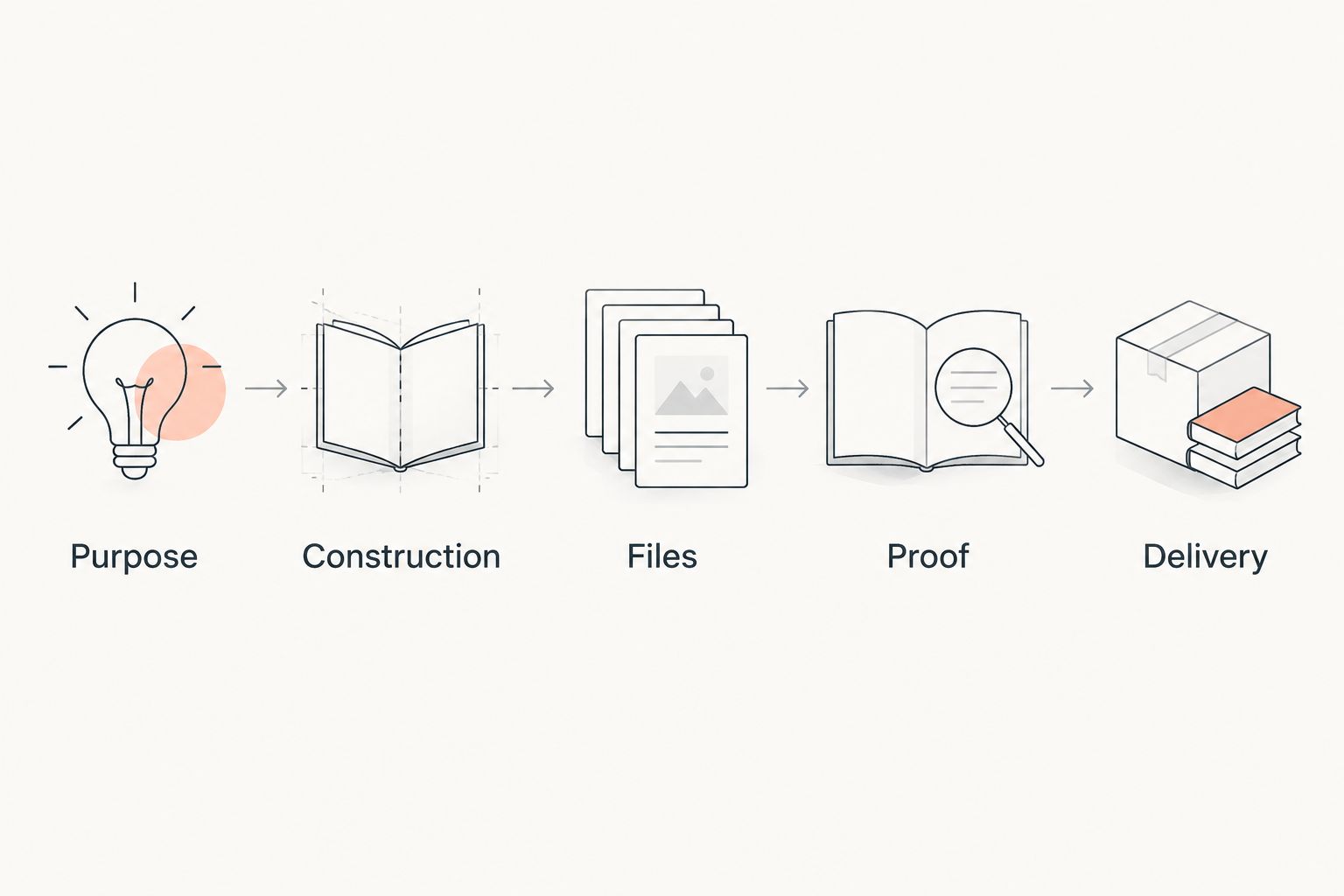
A useful printing brief follows a sequence: Purpose, Construction, Files, Proof, and Delivery. Resolve each stage before asking a provider to commit to the next.
Purpose
Write down who receives the book and how they use it. A conference giveaway, a retail novel, and a training workbook require different buying decisions. State whether you need copies delivered together or books produced against customer orders.
Construction
Specify trim size, page count, binding, interior color, and cover treatment. Mark any requirement that cannot change. If a provider proposes a substitute, ask how that changes handling, appearance, or file preparation.
Files
Follow the selected printer's specifications rather than exporting a generic PDF and hoping it works. For continuous-tone images, 300 pixels per inch at final placed size is a common print-preparation target; enlarging a low-resolution image does not restore missing detail.
Bleed is artwork extending beyond the trim edge. 0.125 inches is a common bleed allowance, not a universal instruction: use the provider's actual template. Typography uses 72 points per inch, but point size alone does not determine readability; typeface, spacing, and contrast also matter.
Proof
Use a physical proof to inspect binding, margins, paper, color, and the cover. A digital proof helps identify layout errors, but it cannot show how the book opens or feels. Keep the approved file version separate from working drafts.
Delivery
Give the destination and the date copies must arrive, not just the event date. Clarify what happens between proof approval and dispatch. Your 2026 schedule should distinguish file preparation, proof review, production, and transit rather than treating them as one deadline.
Which book printing service should you choose?
Choose the production route before choosing the provider. If you need a defined batch delivered to you, start with a direct-printer comparison. If readers will order individual copies through a sales channel, compare print-on-demand publishing workflows.
For the undecided buyer, the next move is a written production brief—not an account signup. Send the same requirements to your shortlisted providers, resolve specification differences, and approve a physical proof before committing to the remaining copies.
FAQ
What’s the best book printing service for a small print run?
The best service depends on whether you need a delivered batch or print-on-demand publishing. Compare a direct printer for batch production, KDP for Amazon-led publishing, and IngramSpark for bookstore-oriented distribution.
Is print-on-demand the same as a short print run?
No. Print-on-demand produces books against orders, while a short print run produces a defined batch. Choose according to how you intend to sell, store, and distribute copies.
Should I choose KDP or IngramSpark?
Choose KDP for an Amazon-led publishing workflow and consider IngramSpark for wholesale distribution. Check the production specifications and distribution requirements against your publishing plan before selecting either route.
Can a printing service get my book into bookstores?
Printing a book does not automatically secure bookstore orders. Distribution makes a title orderable through particular channels, while individual booksellers decide what to purchase and stock.
Do I need a physical proof for a small book order?
Yes, a physical proof is the way to assess the actual paper, binding, margins, and printed appearance before approving further production. A digital proof cannot show how the finished book handles.
What should I send when requesting a book printing quote?
Send the quantity, trim size, page count, binding, interior color requirements, cover requirements, delivery destination, and required arrival date. Identify which specifications are fixed so alternatives do not distort the comparison.
Which service should I consider for a photo book?
Blurb belongs on a photo-book shortlist because visual publishing is a central use case for the service. Compare its available formats with your image layout and inspect a physical proof before approving the project.
One last thing
Proof the book as a reader, not only as an editor. Open it on a table, turn pages near the front and back, and check whether content disappears into the binding. A book can contain perfectly corrected text and still be awkward to use.


