

Best overall: saddle stitch for a short hobby magazine. Best for shelf-kept editions: perfect bound. Best for hands-on projects: plastic coil. Best for an open reference spread: wire-o. This 2026 guide compares the best magazine printing options for niche hobby publications by how your readers use each issue.
- The best magazine printing options for niche hobby publications match binding to reading habits, not appearance alone.
- Dazzle Printing offers magazine printing with saddle stitch, perfect bound, plastic coil, and wire-o bindings.
- Choose saddle stitch for short issues; Dazzle Printing’s maximum is 80 pages.
- Choose perfect bound for collected editions, plastic coil for workbench use, and wire-o for open reference spreads.
Why this matters
A model railway journal, birdwatching magazine, and knitting publication ask readers to do different things. Some readers browse photographs; others follow instructions with both hands occupied. Your binding should support that activity.
Dazzle Printing is best for hobby publishers who need custom magazine printing starting at 25 copies. You can explore Dazzle Printing once you know which format fits your publication.
Start your 2026 print plan with the finished issue, not just its cover. Decide how readers will hold it, whether they will keep it, and whether they need it to stay open beside a project. Those answers make the binding decision much simpler.
What makes the best magazine printing option?
Use these criteria before choosing a binding. A format that looks right on a shelf can still get in the way at a workbench.
- Reading position: Will readers hold the magazine, place it on a table, or consult it while working? Open-page behavior matters most when hands are busy.
- Page count: The finished page count determines which formats deserve consideration. Saddle stitch has an 80-page maximum here.
- Image placement: Full-page photographs and artwork need careful margins. Binding areas should not swallow captions, faces, or essential details.
- Collection value: Decide whether the publication is a current issue to browse or a reference edition readers will keep and revisit.
- Production planning: The minimum print quantity is 25 copies. Plan the quantity around your publication’s actual distribution needs.
- Proof readiness: Finalize page order, margins, captions, and cover details before approval. Production timing starts after proof approval, not when you begin designing.
For a 2026 launch, separate the editorial deadline from the printing deadline. Dazzle Printing ships in 4 to 6 days after proof approval; shipping transit comes after that. Do not treat the ship date as the reader’s delivery date.
Magazine printing options at a glance
These rankings compare binding choices, not competing printers. Each option earns a different use case, so the strongest choice depends on what your issue needs to do.
| Rank and option | Best for | Standout feature | Key limitation |
|---|---|---|---|
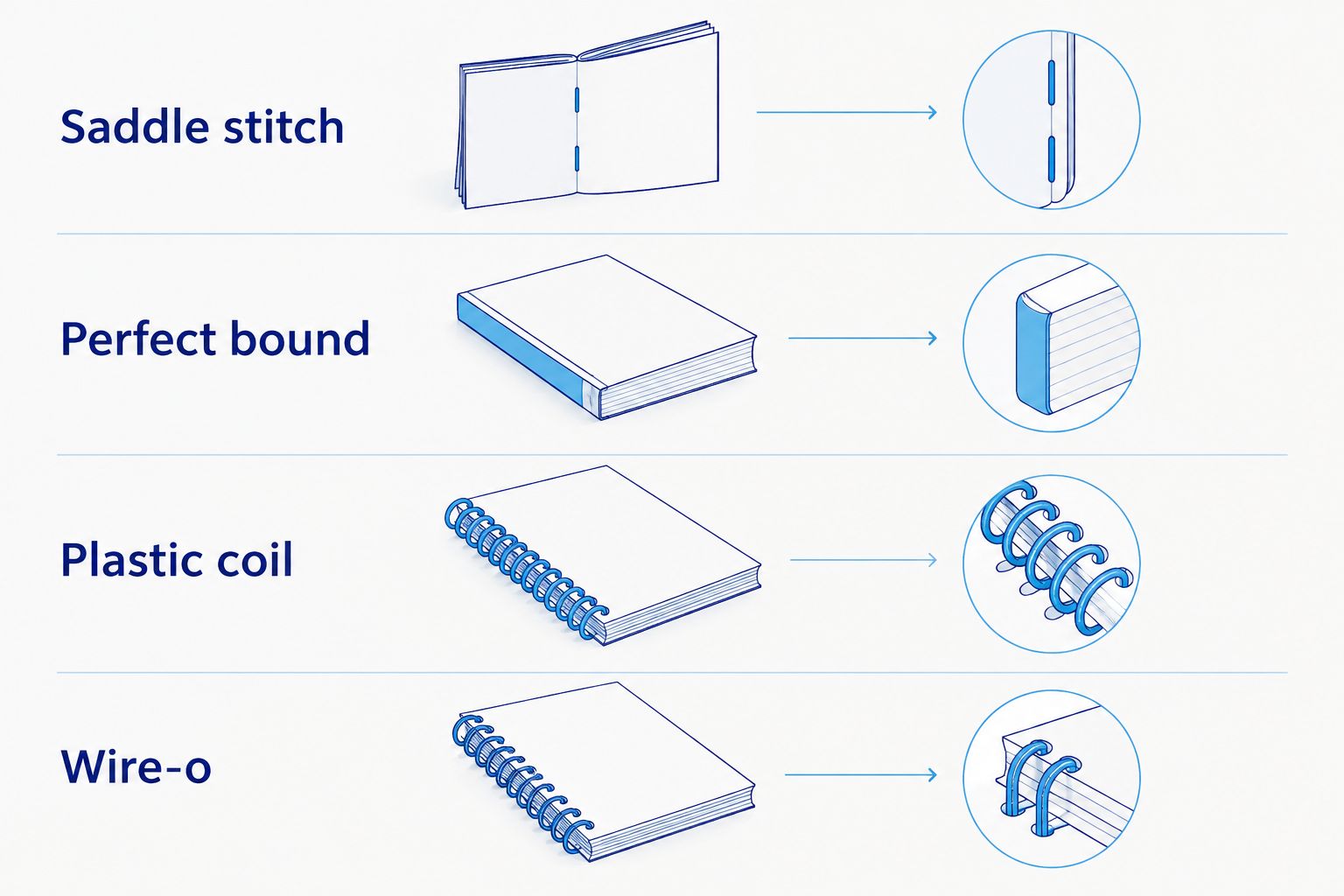
| Saddle stitch | Short, browseable hobby issues | Folded pages held together at the fold | Maximum 80 pages; no broad, flat spine |
| Perfect bound | Shelf-kept editions | Glued spine with a paperback-style shape | Does not naturally lie flat like coil binding |
| Plastic coil | Hands-on project magazines | Pages turn around a continuous coil | Punched binding edge needs clear space |
| Wire-o | Open reference spreads | Facing pages stay accessible on a work surface | Exposed wire loops need protection from crushing |
The table separates reading from doing. Saddle stitch and perfect bound suit familiar magazine reading; plastic coil and wire-o put more emphasis on keeping instructions accessible during an activity.
1. Saddle stitch: best magazine printing for short hobby issues
Saddle stitch holds folded sheets together with staples along the fold. It suits a magazine readers pick up, browse, and pass around, especially when the content mixes articles, photographs, and shorter recurring features.
For a hobby club’s 2026 issue, saddle stitch is the default to consider first when the page count fits. It gives readers a familiar magazine format without an exposed coil or wire edge.
Saddle stitch pros
- Easy browsing: Readers can move through articles and photo features without working around an external binding.
- Compact format: The folded construction suits a short issue intended for regular reading.
- Clear editorial fit: News, member contributions, event reports, and short tutorials can share the same format.
Saddle stitch cons
- Page limit: Dazzle Printing’s saddle stitch maximum is 80 pages. A longer issue needs a different binding or an editorial reduction.
- Limited spine identification: The folded edge does not provide the broad, flat spine of a perfect-bound publication.
Best for: Short club magazines, hobby news, and browseable issues with varied articles.
Check the page plan before finalizing the design. Folded-sheet construction generally calls for page counts in multiples of 4; confirm how the cover and any blank pages are counted for your order. Do not add filler merely to reach a page count when a useful contents page or contributor information would serve readers better.
Verdict: Buy saddle stitch for a short, conventional hobby magazine within the page limit.
2. Perfect bound: best magazine printing for shelf-kept editions
Perfect binding attaches the page block to a cover at a glued spine. The result has a paperback-style shape that suits an edition readers intend to keep rather than treat as a quick update.
Choose this direction for an annual collection, a substantial themed issue, or a magazine built around detailed articles. The format supports the publication’s role as something readers can return to on a bookshelf.
Perfect bound pros
- Shelf-friendly shape: A defined spine gives a collected edition a book-like form.
- Long-form reading: The format suits extended articles, interviews, and substantial editorial sections.
- Collection consistency: A recurring series can use a consistent cover and spine design, subject to the finished dimensions.
Perfect bound cons
- Less convenient hands-free reading: A glued-spine publication does not naturally stay flat like a coil-bound one.
- Gutter sensitivity: Text and important image details need space away from the inner binding edge.
Best for: Collector editions, annual hobby journals, and substantial themed publications.
A spine does not automatically guarantee usable space for a title. Its width depends on the finished page block, so confirm the cover dimensions before placing spine lettering. Keep essential identifiers on the front cover as well.
For a 2026 collector edition, design the cover after the page count and paper choice are settled. A late editorial change can affect the cover file as well as the interior.
Verdict: Buy perfect bound when keeping and shelving the issue matters more than hands-free use.
3. Plastic coil: best magazine printing for hands-on projects
Plastic coil threads through holes along the page edge. Readers can open the publication flat or fold pages back, making the format useful when instructions need to sit beside tools, materials, or an unfinished project.
This is a functional choice for project-heavy content. Think sewing techniques, model-building sequences, or workshop exercises where the reader repeatedly checks a page while doing something else.
Plastic coil pros
- Hands-free access: Open pages can remain accessible while readers work.
- Fold-back use: Readers can turn the publication back on itself to reduce its footprint on a table.
- Instructional fit: Step sequences, diagrams, and checklists benefit from an accessible page.
Plastic coil cons
- Binding-edge space: Holes occupy part of the page edge, so artwork and text need a clear margin.
- Less conventional magazine appearance: An exposed coil changes the publication’s look and handling compared with a folded or glued spine.
Best for: Project magazines that readers actively use during a hobby session.
Build the layout around the working page. Put a task’s materials, instructions, and essential diagram together where possible, rather than forcing repeated page turns with occupied hands.
A fold-back format also changes how you should think about spreads. An attractive image across facing pages is less useful if the reader normally folds one page behind the other. Design each working page to make sense on its own.
Verdict: Buy plastic coil when the magazine functions as a working guide, not just reading material.
4. Wire-o: best magazine printing for open reference spreads
Wire-o uses paired wire loops through holes along the binding edge. It lets a publication open flat, making it useful when readers need to consult facing pages together.
Choose wire-o for reference-led content such as paired diagrams, comparison charts, or technique notes arranged across a spread. Its strongest role is a publication that stays open on a desk or hobby bench.
Wire-o pros
- Open-spread access: Readers can consult facing pages without holding a glued spine open.
- Reference-friendly handling: The format supports repeated consultation during a task.
- Useful page organization: Related instructions and illustrations can remain visible together.
Wire-o cons
- Exposed loops: Wire binding needs protection from being crushed during handling and storage.
- Interrupted inner edge: Punched holes and wire loops make the binding area unsuitable for essential details.
Best for: Desk-based reference magazines built around facing-page instructions or diagrams.
Do not place a tiny label or a critical measurement directly beside the punched edge. Give each page enough independent context that readers can understand it without searching across the binding.
Plastic coil and wire-o share useful open-page behavior. Choose between them after considering whether your layout favors individual fold-back pages or paired reference spreads, then confirm the finished construction with the printer.
Verdict: Buy wire-o for reference spreads; skip it when exposed loops conflict with your storage needs.
How the options rank
The ranking follows reading position, page count, image placement, collection value, and production planning. Saddle stitch takes the default slot for a short, conventional magazine; the other options solve more specific reading problems.
This is a format comparison, not a print-quality test. Binding alone does not establish color accuracy, paper suitability, or the quality of your files. Evaluate those separately when preparing your order and reviewing the proof.
Which magazine printing option should you choose?
Choose saddle stitch unless the content gives you a clear reason to choose something else. Move to perfect bound for a shelf-kept edition, plastic coil for hands-on instructions, or wire-o for open reference spreads.
Before committing your 2026 issue, make a physical mock-up using ordinary paper. You do not need a finished cover to discover that a diagram sits too close to the binding or that an instruction sequence requires awkward page turns.
Use this short decision sequence:
- Set the reading task: Browse articles, keep an edition, complete a project, or consult a spread.
- Check the page plan: Confirm the finished count and whether saddle stitch remains suitable.
- Review the binding edge: Move captions, diagrams, and essential text clear of the affected area.
- Approve the proof: Check the final files before starting the production schedule.
Choose your magazine format
Match your page count and reading task to the binding before ordering.
FAQ
What’s the best binding for a small hobby magazine?
Saddle stitch is the default choice for a short, browseable hobby magazine. Choose another binding when the page count, shelf storage, or hands-free reading needs call for it.
Is perfect binding better than saddle stitch for a collector issue?
Perfect binding is the stronger fit when you want a paperback-style edition readers can keep on a shelf. Saddle stitch remains suitable for shorter issues that readers mainly browse.
What is Dazzle Printing’s minimum magazine print quantity?
Dazzle Printing’s minimum print quantity is 25 copies. Use your planned distribution to decide the order quantity rather than choosing a binding around an assumed audience size.
How many pages can a saddle stitch magazine have?
The saddle stitch maximum offered here is 80 pages. Confirm the complete page count, including the cover treatment and any blanks, before finalizing your files.
Which magazine binding works best for hands-on hobby instructions?
Plastic coil is a strong choice for hands-on instructions because pages can open flat or fold back. Wire-o also suits reference content that needs to remain open on a work surface.
Can a photograph run across the middle of a magazine?
A photograph can span facing pages, but important details should stay away from the binding area. Review alignment and the inner margins carefully, especially when a face, caption, or diagram crosses the center.
When does the printing schedule start?
The schedule starts after proof approval. The stated shipping window is 4 to 6 days after approval; allow separately for transit to your destination.
Should every issue of a hobby magazine use the same binding?
Use the same binding when the page count and reading task remain consistent. A collected annual or project-focused special edition can justify a different format without changing the regular magazine.
One last thing
Test the most demanding page, not just the cover. Open your mock-up to the densest diagram or longest instruction sequence and use it in the position your reader will use it.
If you must hold the page down, hunt for a caption near the binding, or turn pages mid-task, fix that problem before proof approval. A useful hobby magazine earns its place by making the reader’s next project easier.


