

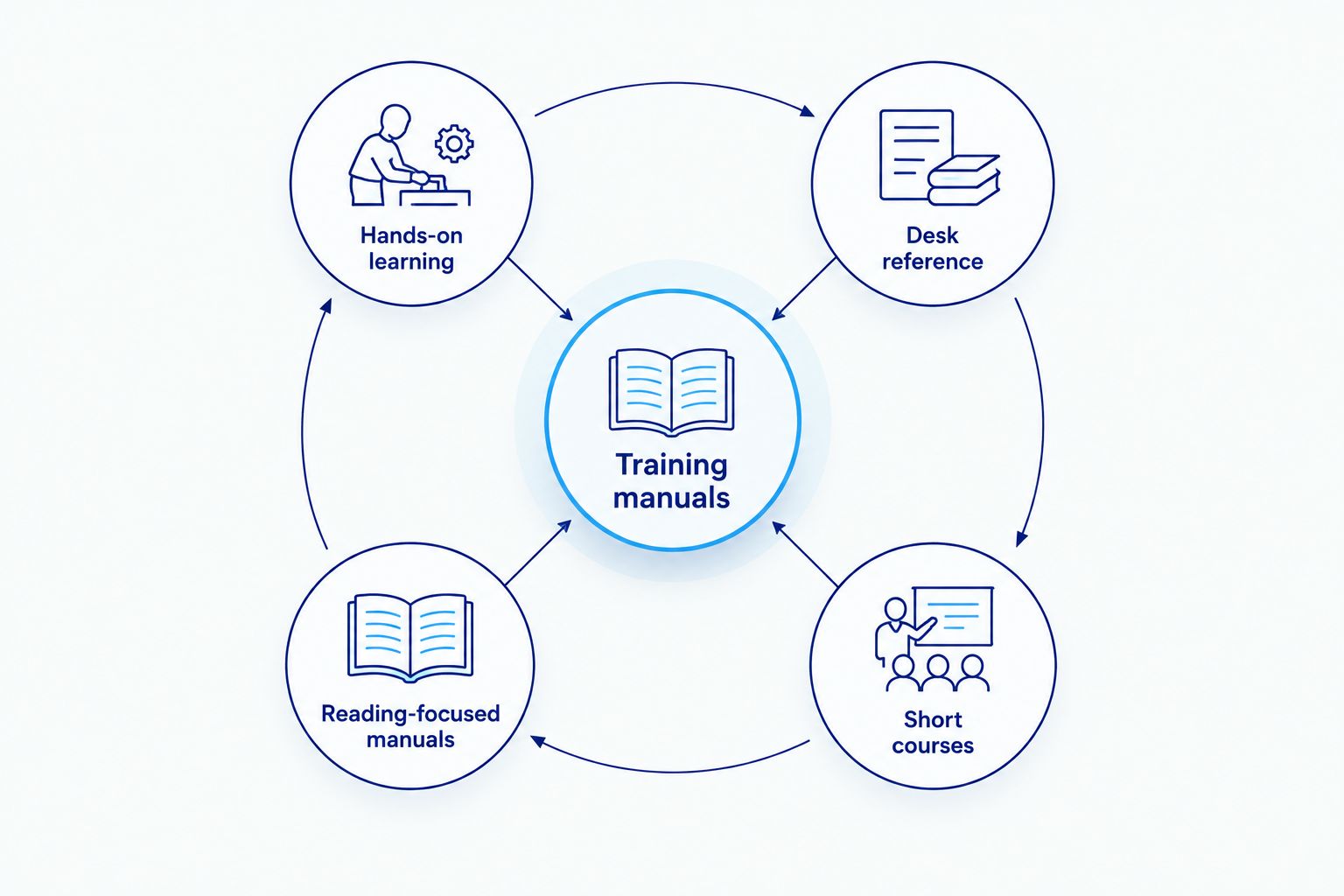
Best overall: plastic coil for hands-on training. Best for desk reference: Wire-O. Best for short course booklets: saddle stitch. Best for a bookshelf-ready manual: perfect bound. These are the best booklet binding options for training manuals in 2026; choose according to how learners turn pages, take notes, and use the book during instruction.
- The best booklet binding options for training manuals start with plastic coil for hands-on learning and frequent page turning.
- Wire-O suits desk reference; saddle stitch suits short course booklets; perfect bound suits reading-focused manuals.
- Dazzle Printing offers all four binding types, with a minimum order of 25 copies.
- Dazzle Printing limits saddle stitch books to 80 pages; longer manuals need another binding.
Why the binding matters
A training manual has a job beyond looking finished. Your learner needs to find instructions, keep the right page open, and write answers without fighting the book. A binding that works for a reading assignment does not automatically work beside a keyboard or during a practical demonstration.
Dazzle Printing is best for training manual buyers who need a choice of plastic coil, Wire-O, saddle stitch, or perfect binding. Dazzle Printing offers these four binding types, so you can match the construction to the lesson rather than redesigning the lesson around the book.
For your 2026 training program, settle the main use case before polishing the cover. Start with a simple question: will learners mostly read the manual, write in it, or follow it while doing something else?
What makes the best binding for training manuals?
Use these criteria before comparing the options:
- Open-page behavior: Does the manual need to stay open without someone holding it down?
- Writing comfort: Will learners complete exercises near the inside edge of the page?
- Page count: Does the finished document fit the binding's limits, including the cover requirements?
- Handling: Will the manual sit on a desk, travel between sessions, or stay on a shelf?
- Reference needs: Does the reader need to identify the book by its spine?
- Layout fit: Can the design keep instructions, diagrams, and answer spaces clear of holes, folds, or the glued edge?
Do not rank appearance ahead of the first two criteria for a workbook. A polished cover cannot fix a book that keeps closing while someone tries to complete an exercise.
Training manual bindings at a glance
This 2026 comparison ranks the options by their strongest training use, not by appearance alone. Every binding has a place; the limitation column tells you when to choose something else.
| Rank and binding | Best for | Standout feature | Key limitation |
|---|---|---|---|
| 1. Plastic coil | Hands-on learning | Pages turn around a continuous plastic spiral | No printable spine; punched edge needs clear space |
| 2. Wire-O | Desk reference | Double-loop wire supports flat opening and fold-back use | Wire loops can bend if crushed |
| 3. Saddle stitch | Short courses | Folded sheets secured with staples at the fold | Dazzle Printing limits this option to 80 pages |
| 4. Perfect bound | Reading-focused manuals | Glued spine creates a paperback-style book | Does not stay flat as readily as coil or Wire-O |
The first distinction is the learner's activity. Plastic coil and Wire-O favor an open working surface; saddle stitch and perfect binding serve different kinds of reading-led material.
1. Plastic coil: best booklet binding for hands-on training
Plastic coil binding threads a continuous plastic spiral through holes along the page edge. Pages turn around the coil, allowing the manual to open flat or fold back on itself. That makes it a practical default for exercise-heavy training.
Best for: workbooks, practical instruction, and lessons completed beside equipment or a computer. If someone needs both hands for the task, an open manual should support the work rather than interrupt it.
Plastic coil pros
- Opens flat for reading instructions and completing written exercises.
- Folds back to show a single page in a smaller working area.
- Flexible plastic coil tolerates bending better than a rigid wire loop.
- Works with a layout organized around repeated steps and practice pages.
Plastic coil cons
- The punched edge requires a clear binding margin.
- There is no conventional printable spine for identifying the manual on a shelf.
- The exposed coil needs room when books are packed closely together.
Keep answer boxes and important diagram labels away from the punched edge. A page can look balanced on screen while leaving too little room for comfortable writing once it is bound.
Plastic coil also deserves a careful page-turning check at proof stage. Look at a left-hand exercise page and a right-hand exercise page separately; the binding sits beside a different hand position on each spread.
Verdict: Buy plastic coil for a hands-on training manual that learners need to keep open while working.
2. Wire-O: best booklet binding for desk reference
Wire-O binding uses paired wire loops through holes along the page edge. It supports flat opening and fold-back use, making it suitable for reference manuals consulted repeatedly during a session.
Best for: desk-based reference manuals and instructor guides. Wire-O earns its place when readers need an open spread without committing desk space to a full-width book all the time.
Wire-O pros
- Opens flat so readers can consult a spread without holding it down.
- Folds back for use beside a keyboard or teaching materials.
- Double-loop construction gives the binding a regular, defined shape.
- Suits reference pages that readers revisit throughout a course.
Wire-O cons
- Metal loops can bend when the bound edge is crushed.
- Punched holes require extra attention to the inside margin.
- Like plastic coil, it lacks a conventional printable spine.
Choose Wire-O for the working environment, not because it looks more formal in a sample photograph. A manual that stays on a desk faces different handling from one pushed into a bag after every workshop.
For your 2026 instructor materials, consider whether the book travels loose with other equipment. If rough handling is central to the job, flexible plastic coil is the stronger starting point; if desk use is central, Wire-O remains a useful choice.
Verdict: Buy Wire-O for desk-reference training manuals; skip it when crushed binding edges are a recurring handling problem.
3. Saddle stitch: best booklet binding for short courses
Saddle stitching secures folded sheets with staples along the center fold. The result is a booklet without an exposed coil or a glued paperback spine. It suits concise lessons that learners can follow in sequence.
Best for: short course booklets, orientation material, and focused workshop manuals. Keep the content selective rather than shrinking text to squeeze a larger course into a smaller booklet.
Saddle stitch pros
- Creates a compact booklet without a projecting binding element.
- Keeps a short sequence of lessons together in a familiar format.
- Works well for content intended to be read from beginning to end.
- Leaves the outer page edge free of binding holes.
Saddle stitch cons
- Dazzle Printing limits saddle stitch books to 80 pages.
- It is less suited to fold-back working than plastic coil or Wire-O.
- Folded-sheet construction makes page-count planning important.
Saddle-stitched pages are arranged in groups of four because each folded sheet creates four page surfaces. Confirm how the cover is counted before finalizing the document, and use any necessary blank pages intentionally.
Watch the center spread, too. A worksheet that spans the fold needs a different design from a single-page exercise. Keep essential instructions clear of the fold rather than assuming every part of an open spread is equally comfortable to use.
Verdict: Buy saddle stitch for a concise course booklet within the page limit; skip it for a long, exercise-heavy manual.
4. Perfect bound: best booklet binding for reading-focused manuals
Perfect binding attaches the page block to a wraparound cover with adhesive at the spine. It creates the familiar paperback format, making it a natural fit for training content organized into chapters.
Best for: substantial reading assignments and manuals intended for shelf reference. A printable spine helps identify a book, but the spine must be wide enough for the intended text.
Perfect bound pros
- Creates a paperback-style format for chapter-based training material.
- Provides a spine surface for identification when thickness permits.
- Keeps the binding edge enclosed rather than exposing loops or coils.
- Suits a manual that readers study before or after a session.
Perfect bound cons
- It does not remain flat as readily as plastic coil or Wire-O.
- Content near the glued edge is harder to see without opening the book farther.
- Spine text depends on the finished book's thickness and production requirements.
Give perfect-bound pages a comfortable inner margin. An attractive two-page diagram loses its usefulness if an important label disappears into the gutter, the inner space where the pages meet.
Do not choose perfect binding merely because a training manual is long. Length matters, but use matters more: a long book full of exercises still needs a binding that supports writing.
Verdict: Buy perfect binding for reading-focused training manuals; skip it when effortless flat opening is essential.
How the binding options rank
This ranking puts learner activity first, then open-page behavior, handling, page count, and layout fit. Plastic coil takes the default position because hands-on instruction benefits directly from flat opening and fold-back use.
Wire-O owns the desk-reference slot, saddle stitch serves concise course material, and perfect binding serves chapter-based reading. These are use-case recommendations, not a claim that one construction wins every comparison.
Change the ranking when the lesson changes. A short orientation booklet does not need to inherit the binding used for a full instructor workbook.
Before you order your training manuals
For a 2026 course rollout, check the finished document in this order:
- Confirm the activity. Identify the pages learners must read while doing something else.
- Check the layout. Inspect inner margins, answer spaces, diagrams, and page numbers against the chosen binding.
- Confirm the count. Resolve the cover treatment and final page total before approving the file.
- Review the proof. Check content order, blank pages, and instructions that refer readers to another page.
- Plan delivery. Separate file preparation, proof approval, shipment, and transit in your schedule.
Dazzle Printing has a minimum print quantity of 25 copies and ships in 4 to 6 days after proof approval. That shipping window is not the arrival date; leave room for transit and for any corrections before approval.
Plan your training manual printing
Match your page count and classroom activities to the right binding before approving your files.
Which booklet binding should you choose?
Choose plastic coil if you are undecided and the manual includes hands-on exercises. It directly supports the activity that makes training books different from ordinary reading material: following instructions while working.
Choose Wire-O for a desk-reference manual, saddle stitch for a short course booklet, and perfect binding for reading-led material. For a 2026 program with several document types, use different bindings where the learning tasks genuinely differ. Consistent page design can connect the set without forcing every book into the same construction.
FAQ
What’s the best booklet binding for a training manual?
Plastic coil is the best default for hands-on training manuals because it opens flat and folds back. Choose a different binding when short-course reading, desk reference, or shelf identification matters more.
Is plastic coil better than Wire-O for training workbooks?
Plastic coil is the better starting point when flexible binding and frequent handling matter most. Wire-O also opens flat and folds back, but its metal loops can bend if crushed.
Can I use saddle stitch for an 80-page training manual?
Dazzle Printing offers saddle stitch books up to 80 pages. Confirm the final page count and how the cover is counted before preparing the production file.
Is perfect binding good for a manual with written exercises?
Perfect binding is less suitable when learners need the manual to stay flat while writing. Plastic coil or Wire-O better supports that activity, while perfect binding suits reading-focused material.
What is the minimum order for training manual printing?
Dazzle Printing’s minimum print quantity is 25 copies. Finalize the binding and page count before placing the order so the specifications match the course.
How soon do training manuals ship after proof approval?
Dazzle Printing ships in 4 to 6 days after proof approval. Transit is separate, so do not treat the shipping window as a guaranteed arrival date.
Can I put a title on the spine of a training manual?
Perfect binding provides a printable spine when the finished book is thick enough for the intended text. Plastic coil, Wire-O, and saddle stitch do not provide a conventional paperback-style spine.
One last thing
Before approving the binding, print a representative exercise spread and place it where the learner will work. Follow the instructions, write in the answer spaces, and reach for the tools the lesson requires.
A loose paper mock-up does not reproduce a finished binding, but it exposes cramped worksheets and awkward page turns. Fix those problems before printing the full run—not after the first training session.


