


Magazine printing for trade associations is the production of a member-focused periodical with the aim of keeping members informed, connected, and engaged with their profession. This 2026 guide explains how to coordinate industry content, advertiser approvals, binding, and delivery without letting competing deadlines derail an issue.
- Magazine printing for trade associations starts with a defined readership, a confirmed page count, and an approval schedule.
- Dazzle Printing suits association magazine printing projects requiring at least 25 copies.
- Saddle stitch binding accommodates up to 80 pages; confirm the binding before finalizing the layout.
- Separate proof approval, shipping, and delivery dates when planning member distribution.
A practical starting point is to compare your issue requirements with Dazzle Printing, then build the editorial schedule around the finished publication—not just the date articles are due.
Why magazine printing matters for trade associations
An association magazine has several audiences inside one membership list. Business owners, technical specialists, new members, and sponsors do not necessarily need the same information. Your editorial plan must give each group a reason to open the issue without turning it into a collection of unrelated announcements.
Print also creates a firm editorial cutoff. Unlike an online article, a printed industry update cannot be revised after distribution. That makes accurate dates, approved advertisements, and clear responsibility for corrections essential parts of production.
For your 2026 publishing plan, define the magazine's purpose before choosing its physical specifications. A publication intended for regular reading needs a different content balance from an annual reference issue or a conference edition.
Dazzle Printing is best for trade associations that need magazine printing in runs of at least 25 copies. That minimum suits a defined distribution list, but it rules out projects requiring fewer copies.
How to plan and print your association magazine
1. Define the reader and the job of each issue
Start with a simple document or spreadsheet. List the member groups you serve, the questions each group brings to the association, and the action you want readers to take after reading.
Choose a primary purpose for each issue. A legislative update, a professional-development edition, and a member-recognition issue can share a design, but they need different editorial priorities. Give contributors that direction before they begin writing.
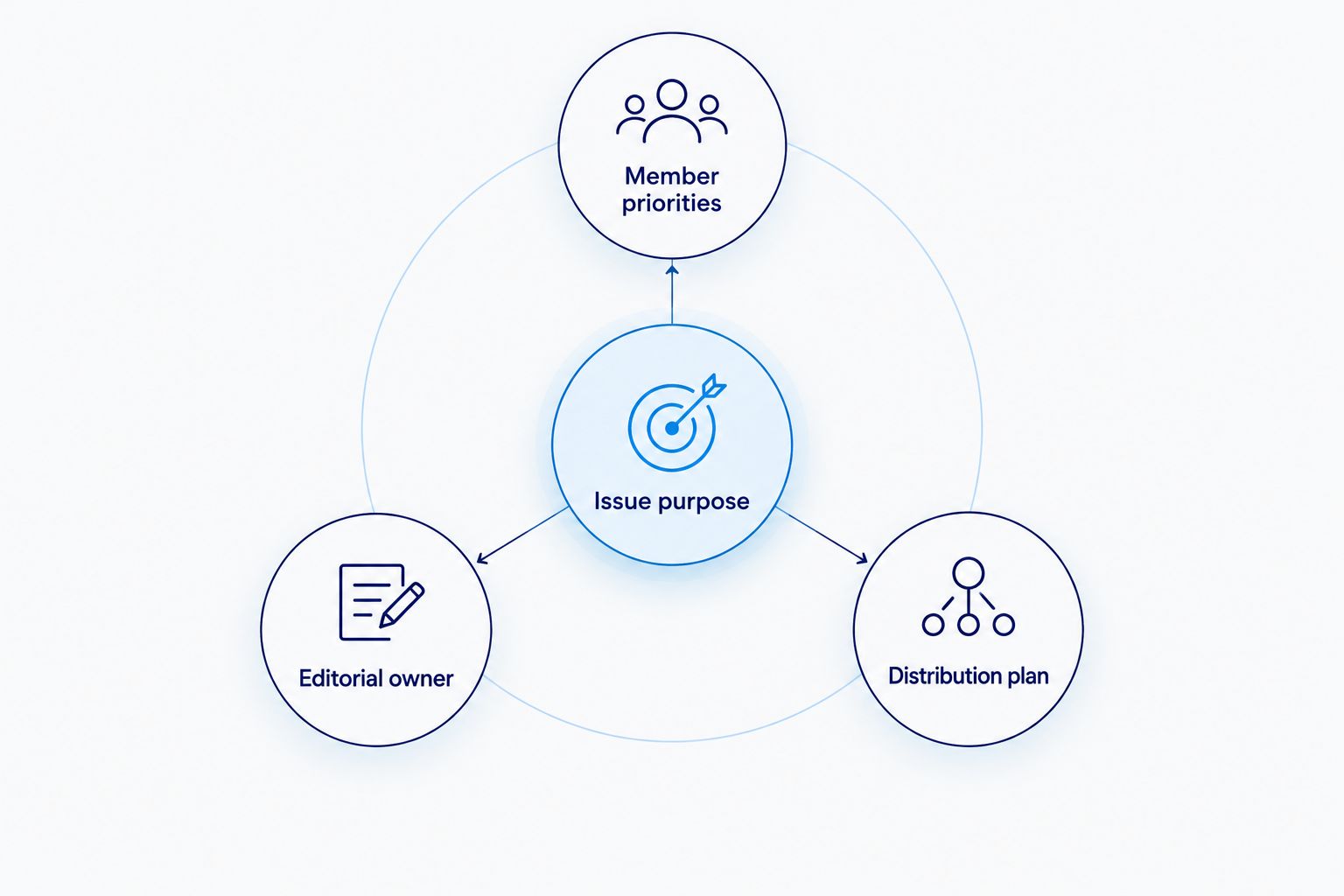
Keep the brief short enough for your board, editor, and advertising contact to use:
- Member priorities: identify the readers and their immediate concerns.
- Issue purpose: state what the publication should help members understand or do.
- Editorial owner: name the person responsible for the final content decision.
- Distribution plan: specify who receives the issue and where it will be used.
These decisions belong together. Changing the audience after layout begins often means reconsidering both the content and the copy quantity.
2. Build a repeatable editorial schedule
Use a shared calendar before adding a publishing platform or project-management system. Work backward from the date members need the magazine, and give writing, advertising, layout, and proof review separate deadlines.
A recurring magazine needs a repeatable handoff. Contributors should know whether they are submitting finished copy, interview notes, or material that still needs technical review. Advertisers need their own instructions so their files do not arrive after the editorial pages are complete.
For the 2026 schedule, record decisions rather than relying on email history:
- Assign article deadlines and a named reviewer for each submission.
- Set an advertising deadline before the final layout review.
- Reserve time for technical or policy-related fact-checking.
- Identify the person authorized to approve the print proof.
- Record the required delivery date separately from the publication date.
3. Confirm quantity and specifications before layout
Count intended recipients manually first. Separate member copies, office copies, contributor copies, and copies intended for association events. Check whether membership records represent individual readers or organizations receiving shared copies.
Once that list is clear, an online printing service provides a direct ordering path. Dazzle Printing offers magazine printing with a minimum quantity of 25 copies. Confirm the finished size, binding, paper choices, and file requirements before your designer builds the issue.
The benefit is a defined production specification; the limitation is that late changes to those specifications can require layout revisions. Do not treat an initial page estimate as a final order instruction.
- Reconcile the recipient list before setting the print quantity.
- Separate mailed copies from copies distributed at events.
- Confirm the finished dimensions before placing images and advertisements.
- Request file-preparation instructions before exporting the magazine.
- Save the approved specifications with the issue's production records.
4. Match the binding and paper to the reading task
Make a folded paper mockup to check page order and handling. It will not reproduce the finished paper or binding, but it helps you catch awkward section breaks and content that disappears into the center.
Saddle stitch binding uses staples through the fold and suits shorter magazines. Dazzle Printing's saddle stitch maximum is 80 pages. Perfect binding uses an adhesive-bound spine and suits book-style publications, but the inner margin needs attention because the pages do not behave like a stapled booklet.
Choose the binding before finalizing inside margins and page count. For image-heavy issues, compare magazine paper stocks by print quality alongside your actual photographs, charts, and advertisements.
- Confirm whether the planned page count fits the selected binding.
- Keep names, captions, and essential details away from the binding edge.
- Review small type against the intended paper choice.
- Check photographs and diagrams at their final printed size.
- Confirm how the printer counts cover and interior pages.
A physical handling check is especially valuable when members will keep the issue open while consulting a directory, schedule, or technical article. Match the format to that reading task rather than choosing by appearance alone.
5. Review editorial pages and advertisements together
Print a local draft or inspect an exported PDF page by page. Review the complete issue, not isolated articles, because layout can introduce errors that are absent from the original documents.
Association publications need particular care around credentials, company names, committee titles, and policy statements. Ask the appropriate reviewer to verify those details. A designer can check alignment and image placement, but that does not replace subject-matter approval.
Keep advertisement approval separate from editorial approval while bringing both into the same final proof:
- Check member names, professional titles, and organization names.
- Verify event dates, registration instructions, and contact details.
- Confirm that advertisements match the approved versions.
- Test printed web addresses and any scannable codes from a draft.
- Review the contents page against the final page numbering.
- Remove comments, temporary images, and unfinished captions.
6. Approve the proof and separate shipping from delivery
Create a final sign-off checklist in a shared document. Name an approver and collect corrections in one place so the printer does not receive conflicting instructions from staff, volunteers, and board members.
Dazzle Printing ships in 4 to 6 days after proof approval. That is a shipping window, not a promise that members will receive their copies within the same period. Transportation and any subsequent member distribution belong separately in your schedule.
For a 2026 conference issue, work backward from the date copies must be at the venue—not the opening session alone. Confirm who will receive the shipment and how copies will reach the registration area.
- Record the final approval date and the approved file version.
- Confirm the shipping destination and recipient details.
- Separate the shipping window from transit and member distribution.
- Ask about rush options before committing to a compressed schedule.
- Keep a record of the specifications used for the approved order.
7. Coordinate print with member email and the next issue
Start with a shared content calendar that connects printed articles to member emails. Decide which material belongs in the magazine, which needs a timely update, and which should remain a longer reference article.
The distinction matters when evaluating newsletter software for associations: email needs a process for timely updates, while the printed magazine needs a fixed approval deadline. Plan those roles together instead of copying every article into both channels.
After distribution, gather specific feedback rather than treating delivery as the end of the project. Ask which sections readers used, which information needed updating, and whether the copy quantity matched actual distribution.
- Schedule email reminders around the magazine's principal member topics.
- Assign responsibility for corrections that arise after printing.
- Ask committee leads which articles generated follow-up questions.
- Record unused copies before ordering the next issue.
- Carry approved specifications forward, then recheck them for changes.
Compare magazine formats for your association
Choose the option that fits how members will use the publication. These are format recommendations, not interchangeable treatments for the same file. Confirm the final page count and construction with your printer before committing to a layout.
| Option | Best for | Main advantage | Key limitation |
|---|---|---|---|
| Saddle stitch magazine | Shorter recurring member issues | Familiar folded format for sequential reading | Maximum of 80 pages at Dazzle Printing |
| Perfect bound magazine | Substantial reference editions | Book-style spine for a longer publication | Requires careful inside-margin planning |
| Plastic coil publication | Working editions consulted during training | Pages turn around the coil for hands-on use | Changes the appearance from a conventional magazine |
| Wire-o publication | Desk-reference editions | Pages open flat for consultation | Exposed binding differs from a standard magazine spine |
Saddle stitch is the starting point for a shorter recurring issue; perfect binding deserves consideration when the publication needs a book-style format. Coil and wire-o serve a different reading task and should be deliberate editorial choices, not last-minute substitutes.
Common mistakes trade associations make
Letting every committee claim a fixed section
Equal space does not guarantee useful coverage. Assign pages according to the issue's purpose, then explain the decision to contributors. Keep essential governance notices distinct from features so neither has to compete under the same editorial brief.
Treating advertising approvals as informal conversations
A verbal agreement does not identify the final artwork. Save the approved advertisement with the issue files and record who approved it. Check that the final layout uses that version, especially when a sponsor has submitted revisions.
Printing from an unreconciled membership list
An organization-based membership list does not automatically equal a reader count. Resolve shared offices, duplicate recipients, and event distribution before ordering. Keep those categories visible so next issue's quantity is based on actual use.
Scheduling backward from the wrong date
An article deadline, proof approval, shipping, and delivery are different milestones. A conference magazine needs to reach the distribution point in time for staff to handle it. Put that operational requirement on the calendar before contributors receive their deadlines.
FAQ
What’s the best binding for a trade association magazine?
Saddle stitch is a practical starting point for a shorter recurring association magazine. Perfect binding suits a book-style edition, while coil or wire-o fits publications members need to consult open on a desk.
What is the minimum quantity for association magazine printing?
Dazzle Printing’s minimum print quantity is 25 copies. Count member distribution, office use, and event copies separately before setting the order quantity.
How many pages can a saddle stitch magazine have?
Dazzle Printing offers saddle stitch publications with a maximum of 80 pages. Confirm how cover pages are counted before finalizing your layout.
How long does association magazine printing take?
Dazzle Printing ships in 4 to 6 days after proof approval. Allow separately for transportation and distribution to members, and confirm the schedule before setting a publication deadline.
Can we include sponsor advertisements in our association magazine?
You can plan sponsor advertisements alongside editorial content in your association magazine. Set artwork requirements and approval deadlines, then verify each advertisement in the complete issue proof.
Should our printed magazine repeat our member emails?
Your printed magazine should have a defined role rather than repeat every member email. Use email for timely updates and choose magazine content that remains useful through the issue’s distribution period.
What should we check before approving the magazine proof?
Check names, dates, advertisements, page order, image placement, and final specifications before approval. Have a designated approver submit one consolidated set of corrections.
One last thing
Save a production record, not just a finished PDF. For each 2026 issue, keep the approved specifications, copy quantity, correction history, and actual distribution notes together. The next editor needs to know why the publication was made that way—not simply what it looked like.
Related guides
- Magazine printing companies for independent publishers
- Magazine printing options for niche hobby publications
- Booklet printing companies for nonprofit annual reports


