


Alumni association magazine printing is the production of bound publications that connect graduates with their school, classmates, and association activities. This guide covers the editorial plan, binding, file preparation, and approval process you need for a 2026 issue, with special attention to class notes, contributor photos, and reunion deadlines.
- Magazine printing for alumni associations starts with readership, page planning, and a clear approval process.
- Dazzle Printing is best for alumni teams ordering at least 25 copies of a custom printed magazine.
- Saddle stitch suits shorter issues; its maximum is 80 pages at Dazzle Printing.
- Approve names, captions, and dates before releasing alumni magazine files for production.
Why magazine printing matters for alumni associations
An alumni magazine gives your association room to connect institutional news with individual graduate stories. A reunion announcement supplies a date; a magazine can also explain who is attending, revisit shared experiences, and introduce the people organizing the event.
The editorial challenge is keeping those different contributions consistent. Class notes, campus photography, donor acknowledgments, and leadership updates need distinct checks before they become one publication. Treat the issue as a coordinated project, not a folder of submissions.
Membership publications also need a repeatable process. The magazine printing guide for trade associations offers a related planning perspective, but an alumni issue needs its own approach to graduation years, personal updates, and school history.
For your 2026 magazine, define success before choosing paper: a readable publication, accurate personal information, and enough time to reach readers before any featured event.
How to plan and print your alumni magazine
1. Define your readership
Start with a shared document and the audience information your association already maintains. Decide whether the issue serves all graduates, a regional chapter, a particular school, or a reunion group. That decision shapes the stories you request and the background you need to explain.
A chapter magazine can focus on local activities; an institution-wide issue needs context for readers who do not follow campus news. Avoid assuming that every graduate recognizes current building names, programs, or staff members.
Write a short editorial brief for contributors. Include the issue's purpose, intended readers, and the action you want readers to take afterward.
- Identify the primary reader group.
- Choose the issue's central purpose.
- Explain unfamiliar campus references.
- Assign an owner to each recurring section.
- Define the reader response you want to encourage.
2. Build your page plan
Use a spreadsheet or a paper mockup to assign space before collecting finished articles. Reserve room for the cover, contents, feature stories, class notes, association updates, and acknowledgments. Count every page in the plan, including intentionally blank pages.
Class notes need particular attention because submissions arrive in uneven lengths. Set a consistent treatment for graduation years, names, locations, and photo captions so the section does not become a collection of unrelated formats.
For a saddle-stitched issue, plan in multiples of 4 pages: folded sheets create four-page groups. Confirm how the printer counts the cover before finalizing your total.
- Map the complete reading order.
- Reserve space for late corrections.
- Group class notes consistently.
- Separate confirmed content from placeholders.
- Check the total against your intended binding.
3. Choose your binding
Make a simple folded mockup first. Turn the pages, locate the center spread, and consider how readers will hold the magazine. This gives your team a practical starting point before comparing professional production options.
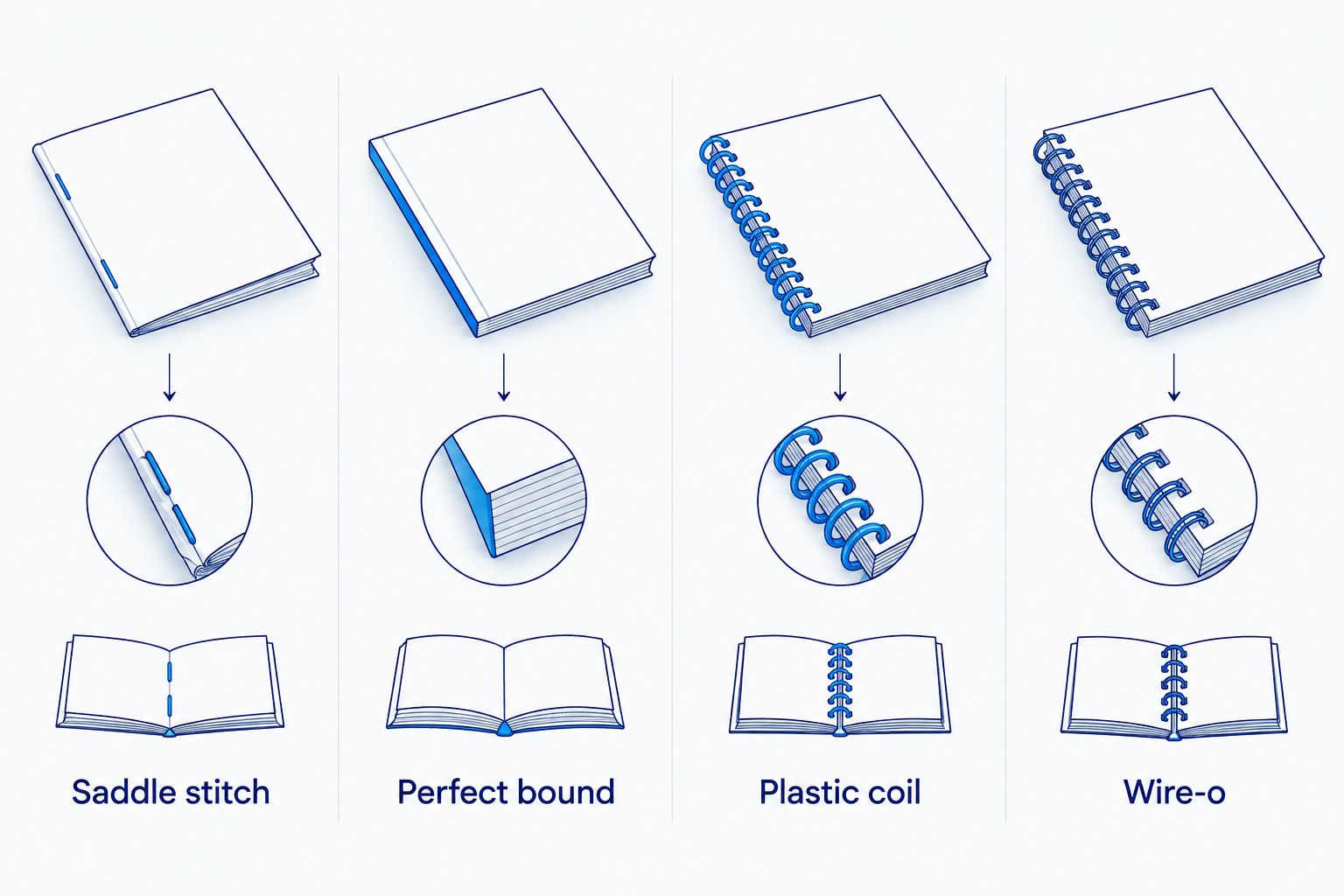
Dazzle Printing offers magazine printing with saddle stitch, perfect bound, wire-o, and plastic coil binding options. Match the binding to the publication's purpose rather than choosing by appearance alone; confirm the page count and paper combination before completing your layout.
Saddle stitch keeps a shorter issue booklet-like. Perfect binding creates a glued spine, while plastic coil and wire-o allow pages to turn around an exposed binding edge. The latter options deserve consideration when the publication also functions as a working reference.
- Use the comparison below to narrow your options.
- Confirm the finished page count.
- Ask about binding-specific inside margins.
- Check artwork that crosses facing pages.
- Resolve cover requirements before final export.
4. Prepare your photographs
Collect original image files in a shared folder rather than copying pictures out of messages or documents. Give each image a matching caption record with names, graduation years where relevant, and permission information. Keep the files connected through consistent filenames.
Older alumni photos deserve an early check. A scan can preserve the character of an archival image, but enlarging it also enlarges scratches, blur, and visible texture. Review the image at its intended printed size instead of judging it only as a small screen preview.
For group photographs, verify the order of names against the actual image. A correct list still produces an incorrect caption when the identification order is reversed.
- Request original files from contributors.
- Record photographer credits and permissions.
- Check image quality at the placed size.
- Verify every person named in a caption.
- Keep important faces away from trim and binding edges.
5. Design for comfortable reading
Begin with a reusable layout in your existing design software. Establish heading styles, body text, captions, and recurring section markers before placing the full issue. Consistency helps readers move between a feature story and a dense class-notes section without learning a new layout.
Print sample pages at their actual size and ask someone outside the design team to read them. Look for text that feels cramped, captions that blend into body copy, and photographs that overpower nearby text. Do not approve readability from a zoomed-in screen alone.
Paper selection belongs in this review. Compare the available stocks for image reproduction, reading comfort, and the feel of the finished issue rather than judging a paper name in isolation.
- Keep body text styling consistent.
- Give class-year headings clear separation.
- Test captions beside their photographs.
- Leave comfortable space near the binding.
- Review representative pages at actual size.
6. Check your print files
Review the exported PDF yourself before sharing it for approval. Exporting can reveal problems that were less obvious in the working file, including missing images, unexpected page breaks, or substituted fonts. Check the PDF in reading order from cover to cover.
Dazzle Printing magazine printing requires the same editorial discipline as any alumni publication: your team must verify the content before approving the proof. A production proof does not replace checking whether a graduate's name, reunion date, or donor acknowledgment is correct.
For the 2026 issue, keep one correction list and one clearly identified approval file. Multiple competing versions make it harder to establish which changes reached the final document.
- Follow the printer's current file specifications.
- Check page size, bleed, and safe margins.
- Confirm fonts and images display correctly.
- Remove comments, placeholders, and draft labels.
- Assign final approval to a named decision-maker.
7. Schedule your release
Work backward from the date readers need the magazine. Put writing, editing, design, proof review, production, shipping, and any onward distribution on separate lines in your schedule. A reunion issue is not ready merely because the files leave your office.
The stated shipping window is 4 to 6 days after proof approval. That is not a promise that magazines will arrive in readers' hands within that window; transit and your association's distribution process need separate planning.
The minimum order is 25 copies. Build the quantity from your actual recipient list, event needs, and archive requirements rather than repeating an old order without checking it.
- Set the reader's required arrival date.
- Establish a firm contributor deadline.
- Reserve time for proof corrections.
- Confirm shipping and distribution arrangements.
- Save the approved file and order specifications.
Compare binding options for an alumni magazine
Saddle stitch is the starting point for a shorter alumni issue; perfect binding deserves consideration for a publication that needs a glued spine. Plastic coil and wire-o suit reference-style publications, but their exposed bindings change the magazine's appearance.
| Option | Best for | Main advantage | Key limitation |
|---|---|---|---|
| Saddle stitch | Shorter recurring alumni issues | Folded, stapled construction suits a booklet format | Maximum of 80 pages at Dazzle Printing; page totals need compatible planning |
| Perfect bound | Alumni editions intended to have a book-like spine | Glued spine gives the publication a different shelf profile | Inside margins need care; confirm that the paper and page count qualify |
| Plastic coil | Alumni reference editions used open on a desk | Pages turn around a flexible coil | Exposed coil changes the look of a conventional magazine |
| Wire-o | Reference-oriented association publications | Wire loops support page turning and open use | Exposed wire needs different cover and margin planning |
Decide with a sample or physical mockup in hand whenever possible. Binding affects how a photograph crosses a spread and how close text sits to the inside edge, so settle it before detailed page design.
Common mistakes alumni associations make
Letting class notes expand without a plan
Unrestricted submissions can consume space reserved for features or association news. Set submission guidance and an editing policy before collecting notes, then tell contributors how you will handle shortened entries.
Publishing personal updates without permission checks
A contributor's willingness to share news with an organizer does not establish permission for every publication channel. Confirm the intended use of personal stories and photos, particularly when an issue also has a public digital version.
Treating an event date as the production deadline
A magazine promoting a reunion needs to reach readers before the reunion. Put the desired arrival date on your 2026 schedule, then work backward through distribution, shipping, proof approval, and file preparation.
Approving design without approving identities
A polished spread can still contain a misspelled surname or the wrong graduation year. Give names, captions, memorial information, and acknowledgments their own editorial review rather than folding them into a general design approval.
Changing specifications after laying out the issue
Switching binding or finished size can require margin changes, image adjustments, and new page breaks. Confirm the physical format before the design team completes the full publication.
FAQ
What’s the best binding for an alumni association magazine?
Saddle stitch is a practical starting point for a shorter alumni magazine. Perfect binding suits editions that need a glued spine, while plastic coil and wire-o deserve consideration for reference-style publications.
Can an alumni association order a small magazine print run?
Dazzle Printing accepts orders starting at 25 copies. Build your quantity from confirmed recipients, event needs, and archive copies rather than assuming a previous issue’s quantity still fits.
How many pages can a saddle-stitched alumni magazine have?
The maximum saddle stitch page count offered by the printer is 80 pages. Plan the publication in multiples of 4 pages and confirm how the cover is included in the order’s page count.
When should we approve an alumni magazine for a reunion?
Approve the magazine early enough to allow production, shipping, and distribution before readers need it. The stated shipping window is 4 to 6 days after proof approval, so do not treat that window as the delivery date.
Can we use old yearbook photos in an alumni magazine?
Use an old yearbook photo only after checking reproduction permission and whether the image works at its intended printed size. Verify the caption independently, including names and graduation years.
Who should approve an alumni magazine proof?
A named final decision-maker should approve the proof after editorial and design checks are complete. Keep corrections in one list so the printer receives one clear, authorized version.
What should we save after printing our 2026 alumni magazine?
Save the approved PDF, source files, image permissions, specifications, and correction record. Keep a physical archive copy as a reference for the next issue’s binding, layout, and editorial planning.
One last thing
Build an alumni name sheet before building the next issue. Record verified spelling, preferred names, graduation years, and caption corrections in an access-controlled document your editorial team can reuse.
That small habit addresses a recurring publishing problem: a name corrected in a proof can return incorrectly when someone copies an older article. Close your 2026 issue by updating the source record, not just the printed page.
Related guides
- Magazine paper stocks ranked by print quality
- Magazine printing companies for independent publishers
- Booklet printing for nonprofit annual reports


